
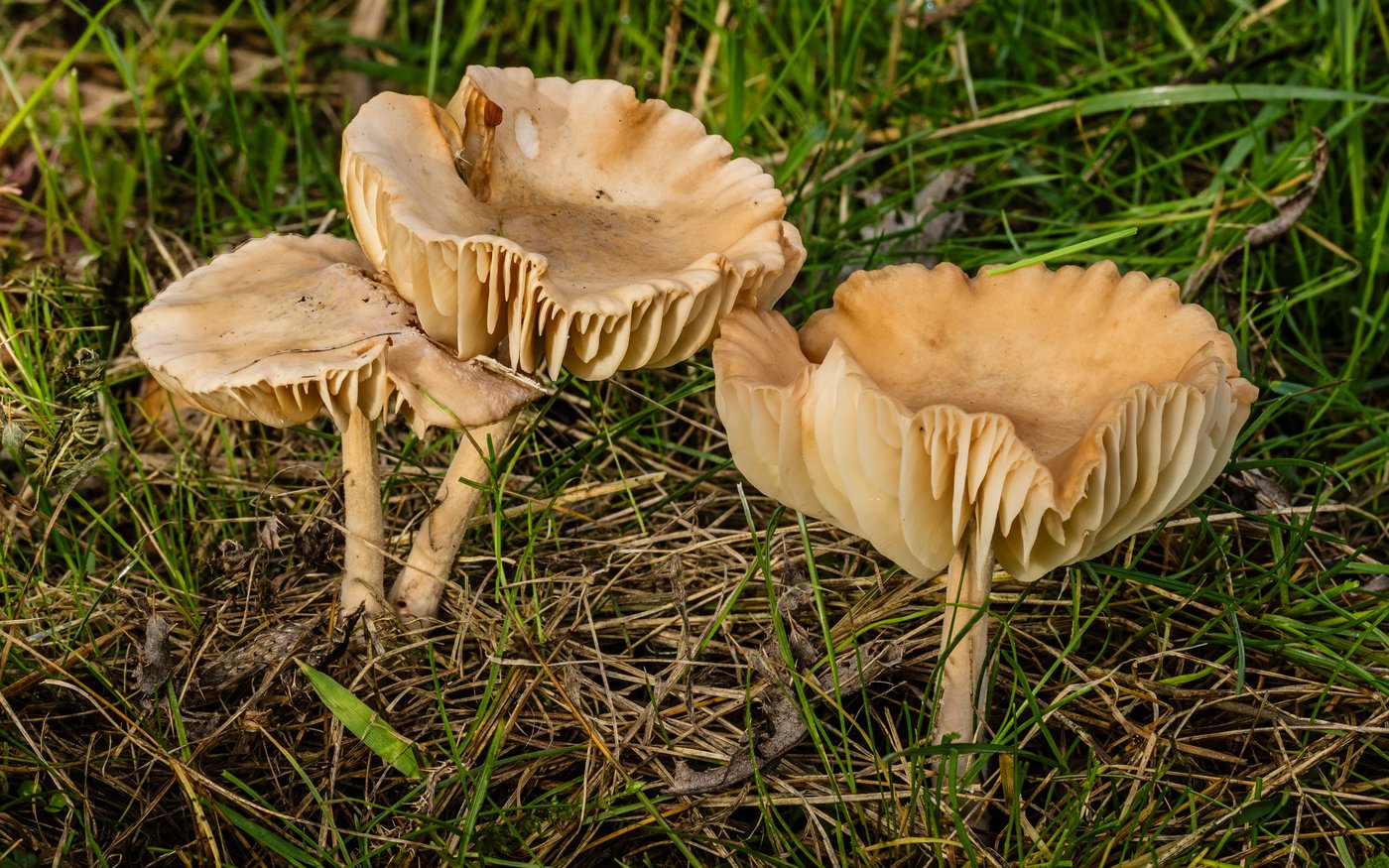
Fairy ring champignon
Marasmius oreades
- Known today as
- A small tan mushroom that grows in rings on lawns and pasture.
- Kind
- Fungus
- Constituents
- trehalose, a cyanide-like odour
- In other databases
- GBIF search · Wikidata search
Revised October 3, 2026: Checked against its sources, each read in full, in part, or in its abstract. Version 1, first published September 25, 2026.
Fairy ring champignon: what was it used for?
A choice edible, which revives when wetted after drying.
Fairy ring champignon: what does modern science say?
The ring is the living edge of the fungus’s mycelium, spreading outward through the soil as the centre dies.
Pharmacognosy & Toxicology
- Constituents
- trehalose ChEMBLwhich lets it revive after drying
- a cyanide-like odourin the gills
- Mechanism
- A choice edible whose trehalose lets it survive drying and revive when wetted. The hazard is its ring-forming lookalike, the fool’s funnel (Clitocybe, now Collybia, rivulosa), whose main toxin is muscarine.
- Toxic dose
- A food.
- Standing
- A food; deaths from the lookalike are rare but possible.
Constituent names open the compound’s record at PubChem, and “ChEMBL” beside a name opens its record at ChEMBL, the European Bioinformatics Institute’s database of bioactive molecules. Where a mechanism line was checked against ChEMBL (ChEMBL 37, read 1 October 2026), the check is shown with the measured value and its source paper, or says plainly that nothing has been measured. Doses are as the references give them, for description only; this is not medical advice. Each source carries the result of its check against Crossref, PubMed, or the authority’s page: see Verification.
Fairy ring champignon: what lore surrounds it?
The rings in the grass were where fairies or elves danced, or, in German tradition, where witches danced on Walpurgis Night; in the Netherlands they were where the Devil set down his milk churn. To step inside one was to risk being held there by the fairies, made to dance to exhaustion, or kept for years.
In Their Own Words
Badham says the champignon dries in two or three days in the air and can then be kept for years without losing its aroma or goodness.
“When dried (two or three days’ exposure to the air is generally sufficient to effect this), the Ag. oreades may be kept for years without losing any of its aroma or goodness”
Charles David Badham, M.D.; edited by Frederick Currey, A Treatise on the Esculent Funguses of England, Agaricus oreades (Plate VII, fig. 4). London: Lovell Reeve & Co., Henrietta Street, Covent Garden, 1863 (second edition; Project Gutenberg eBook #58853). The text, read in part
Cooke calls the fairy-ring champignon small but plentiful and one of the most delicious edible fungi, growing in rings in exposed pastures.
“The fairy-ring champignon Marasmius oreades, Fr., though small, is plentiful, and one of the most delicious of edible fungi. It grows in exposed pastures, forming rings, or parts of rings.”
M. C. Cooke, M.A., LL.D.; edited by the Rev. M. J. Berkeley, Fungi: Their Nature and Uses, Chapter IV, Uses. New York: D. Appleton and Company, 1875 (The International Scientific Series, vol. XV; Project Gutenberg eBook #30181). The text, read in part
McIlvaine says that specimens gathered shrivelled are as good, after soaking, as fresh ones.
“If one knows where the rings are to be found M. oreades can be gathered when shriveled, and are quite as good, after soaking, as when fresh.”
Charles McIlvaine and Robert K. Macadam, Toadstools, Mushrooms, Fungi, Edible and Poisonous; One Thousand American Fungi, Marasmius oreades, species entry. Revised edition; Indianapolis: The Bowen-Merrill Company, copyright 1900, 1902 (Project Gutenberg eBook #51393). The text, read in part
Each passage is quoted from the text named, which the press fetched and read, and was checked word for word against a fresh copy of it; the link opens that copy. Passages are given as printed, without the editors’ footnote numbers, and with words broken across lines joined.
Sources
- Wikipedia contributors. “Marasmius oreades.” Wikipedia, The Free Encyclopedia. en.wikipedia.org/wiki/Marasmius_oreades (read 2 October 2026). Read in full · the text read
- Wikipedia contributors. “Fairy ring.” Wikipedia, The Free Encyclopedia. en.wikipedia.org/wiki/Fairy_ring (read 2 October 2026). Read in full · the text read
- Wikipedia contributors. “Clitocybe rivulosa.” Wikipedia, The Free Encyclopedia. en.wikipedia.org/wiki/Clitocybe_rivulosa (read 2 October 2026). Read in full · the text read
Verification
- Checked
- October 1, 2026, and October 3, 2026
- Passes
- Every sentence read against its sources, in the pass over the remaining 343 entries
- The Standing line checked against the authority it names (EMA, WHO, FDA, CITES, Commission E)
- Every dated or regulatory claim checked by category across the database
- Every source read, in full, in part, or in its abstract, and every sentence checked against what was read (October 3, 2026)
- Sources
- 3 cited: 3 read in full.
- Corrections
- None were needed.
What was checked, how, and what was found is set out on the Verification page. A checked source is one whose record was found; it does not make the entry medical advice.
Cite This Entry
Version 1 · first published September 25, 2026 · last revised October 3, 2026
- Chicago
“Fairy ring champignon.” In Materia Medica, edited by B. C. P. Statema. Version 1. The Thinking Press, 2026–. Last modified October 3, 2026. https://thethinkingpress.org/materia-medica/fairy-ring-champignon.
- MLA
“Fairy ring champignon.” Materia Medica, edited by B. C. P. Statema, version 1, The Thinking Press, 3 Oct. 2026, thethinkingpress.org/materia-medica/fairy-ring-champignon. Accessed 8 Oct. 2026.
- APA
Fairy ring champignon. (2026, October 3). In B. C. P. Statema (Ed.), Materia medica (Version 1). The Thinking Press. Retrieved October 8, 2026, from https://thethinkingpress.org/materia-medica/fairy-ring-champignon
Club members keep entries on a shelf with private notes, print the plates as cards, and receive an entry by email each week. Create a free account before January 1, 2027 and all of it is yours for good. About the Club
See Also
Nearby in the alphabet
False morel (reddish-brown spring mushroom of conifer woods) · Eyebright (Euphrasia officinalis and relatives) · Fennel (seed and water) · The eye bead (white, light blue, and black, like an eye) · Fern seed (mistaken for seed) · The exorcists’ manuals (above all those of the Franciscan Girolamo Menghi) · Feverfew (Tanacetum parthenium) · Eryngo
._Locatie,_Paddenstoelenreservaat._31-10-2022._(actm.)_01.jpg)
Historical description, not medical advice.