
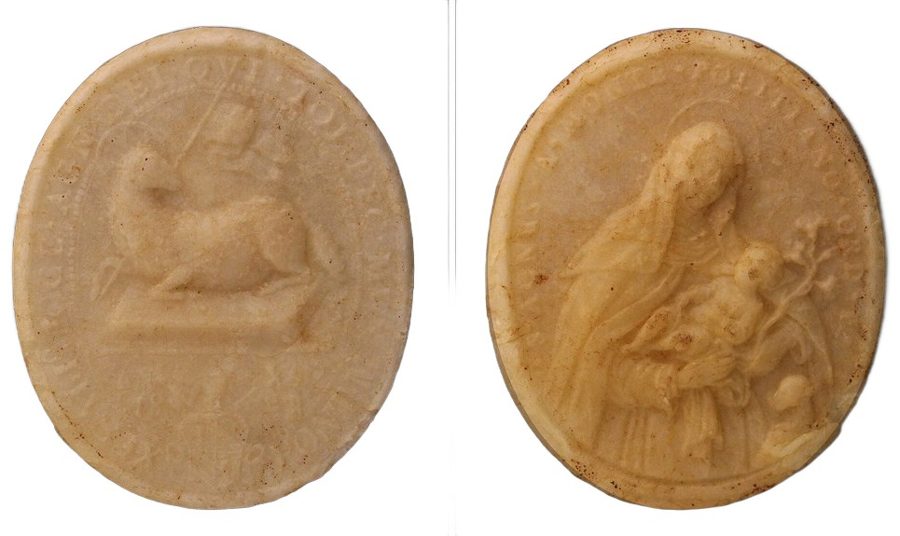
Agnus Dei
- Known today as
- A wax medallion stamped with the Lamb of God, blessed by the pope (note LXX).
- Kind
- Sacramental, in 1 older authority
- Earliest authority here
- The Catholic Encyclopedia (New York, 1907–1914)
- In the Canale glossary
- On the Manner of Discerning and Healing the Bewitched, Appendix A: Treatise Two: Blessed Objects and Materials
Revised October 1, 2026: An authority added from a text read in full. Version 1, first published September 25, 2026.
Agnus Dei: what did Canale use it for?
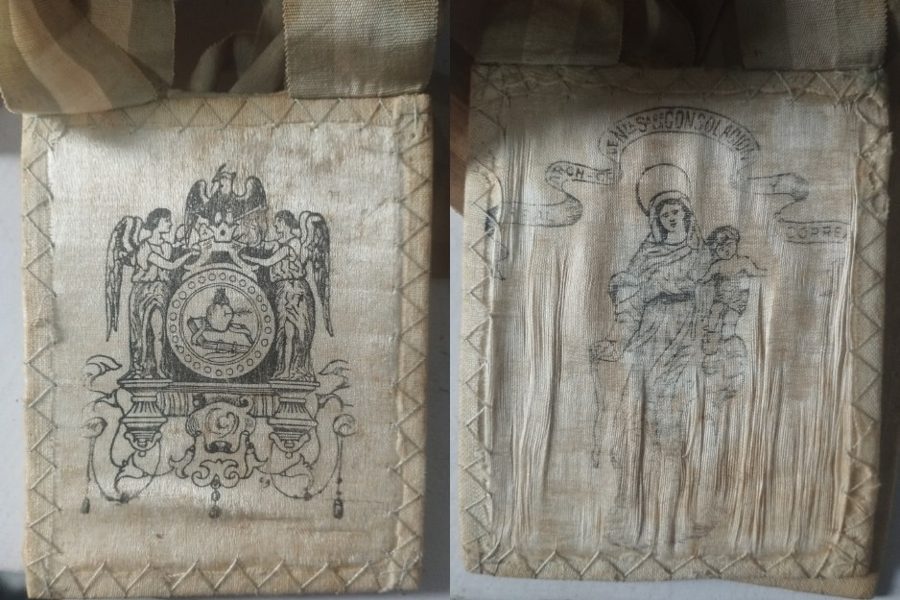
Worn by the sick; placed in pouches in the corners of rooms against hexes; “much, too, has been gathered on their wondrous effects” (Treatise Two).
Agnus Dei: what does modern science say?
The great papal consecration took place in the first year of each pontificate and every seventh year afterwards.
What Medicine Makes of It
- Amulets, Blessed Objects, and the Meaning ResponseWhy what cannot work sometimes works.
Agnus Dei: what lore surrounds it?
Believers credited the blessed wax medallion with protection against storms, fire, floods, shipwreck, poison, epilepsy, and difficult childbirth. Pope Pius V is said to have thrown one into the flooding Tiber, after which the waters receded. Elizabeth I later banned their import into England as “popish trumperies.”
Agnus Dei: what did the older authorities say?
- The Catholic Encyclopedia
- The Catholic Encyclopedia thinks it “probable that they had their beginning in some pagan usage of charms or amulets, from which the ruder populace were weaned by the enjoyment of this Christian substitute blessed by prayer.” The first Agnus Deis (c. 820) “were made of the remnants of the preceding year's paschal candle,” and Ennodius (c. 510) shows “that fragments of the paschal candles were used as a protection against tempests and blight.” As the blood of the paschal lamb protected each household, “so the purpose of these consecrated medallions is to protect those who wear or possess them from all malign influences,” the blessing naming “the perils from storm and pestilence, from fire and flood, and also of the dangers to which women are exposed in childbirth.” Under Elizabeth they were listed among the “popish trumperies” forbidden entry into England, and a grey kind, mixed “with the dust which is believed to be that of the bones of martyrs,” is called the Paste de' SS. Martiri.
Sources
- [21] Herbermann, C. G., et al. (eds.) (1907–1912). The Catholic Encyclopedia. New York: Robert Appleton Company. Online at newadvent.org. Articles: Agnus Dei (H. Thurston); Amulet (M. Hassett); Ash Wednesday (H. Thurston); Bells (H. Thurston); Holy Oils (H. Leclercq); Paschal Candle (H. Thurston); Scapular (J. Hilgers). Read in part · the text read
- Papal Artifacts, “Agnus Dei.” Book, not indexed
- National Catholic Register, on the Agnus Dei. Book, seen in reviews
- The Catholic Encyclopedia (New York, 1907–1914), “Agnus Dei.” newadvent.org/cathen/01220a.htm Standard reference work
Verification
- Checked
- October 1, 2026
- Passes
- Every dated or regulatory claim checked by category across the database
- Each quotation from the older authorities checked word for word against the text, read in full
- Sources
- 4 cited: 1 read in part, 1 standard reference work, 1 book, seen in reviews, 1 book, not indexed.
- Corrections
- None were needed.
What was checked, how, and what was found is set out on the Verification page. A checked source is one whose record was found; it does not make the entry medical advice.
Cite This Entry
Version 1 · first published September 25, 2026 · last revised October 1, 2026
- Chicago
“Agnus Dei.” In Materia Medica, edited by B. C. P. Statema. Version 1. The Thinking Press, 2026–. Last modified October 1, 2026. https://thethinkingpress.org/materia-medica/agnus-dei.
- MLA
“Agnus Dei.” Materia Medica, edited by B. C. P. Statema, version 1, The Thinking Press, 1 Oct. 2026, thethinkingpress.org/materia-medica/agnus-dei. Accessed 8 Oct. 2026.
- APA
Agnus Dei. (2026, October 1). In B. C. P. Statema (Ed.), Materia medica (Version 1). The Thinking Press. Retrieved October 8, 2026, from https://thethinkingpress.org/materia-medica/agnus-dei
Club members keep entries on a shelf with private notes, print the plates as cards, and receive an entry by email each week. Create a free account before January 1, 2027 and all of it is yours for good. About the Club
See Also
Also in The Catholic Encyclopedia
The aspergillum in The Catholic Encyclopedia · AGLA in The Catholic Encyclopedia · Bells in The Catholic Encyclopedia · Abracadabra in The Catholic Encyclopedia · everything The Catholic Encyclopedia names →
Nearby in the alphabet
Agrimony (Agrimonia eupatoria) · Alkanet (Alkanna tinctoria (syn) · Agarwood (oud) · Aloe (Here the aloe of John 19) · Aflatoxin mould · Alum (Potassium aluminum sulfate) · Adder’s-tongue fern (Ophioglossum vulgatum)


Historical description, not medical advice.