
Ergot
Secale cornutum
- Known today as
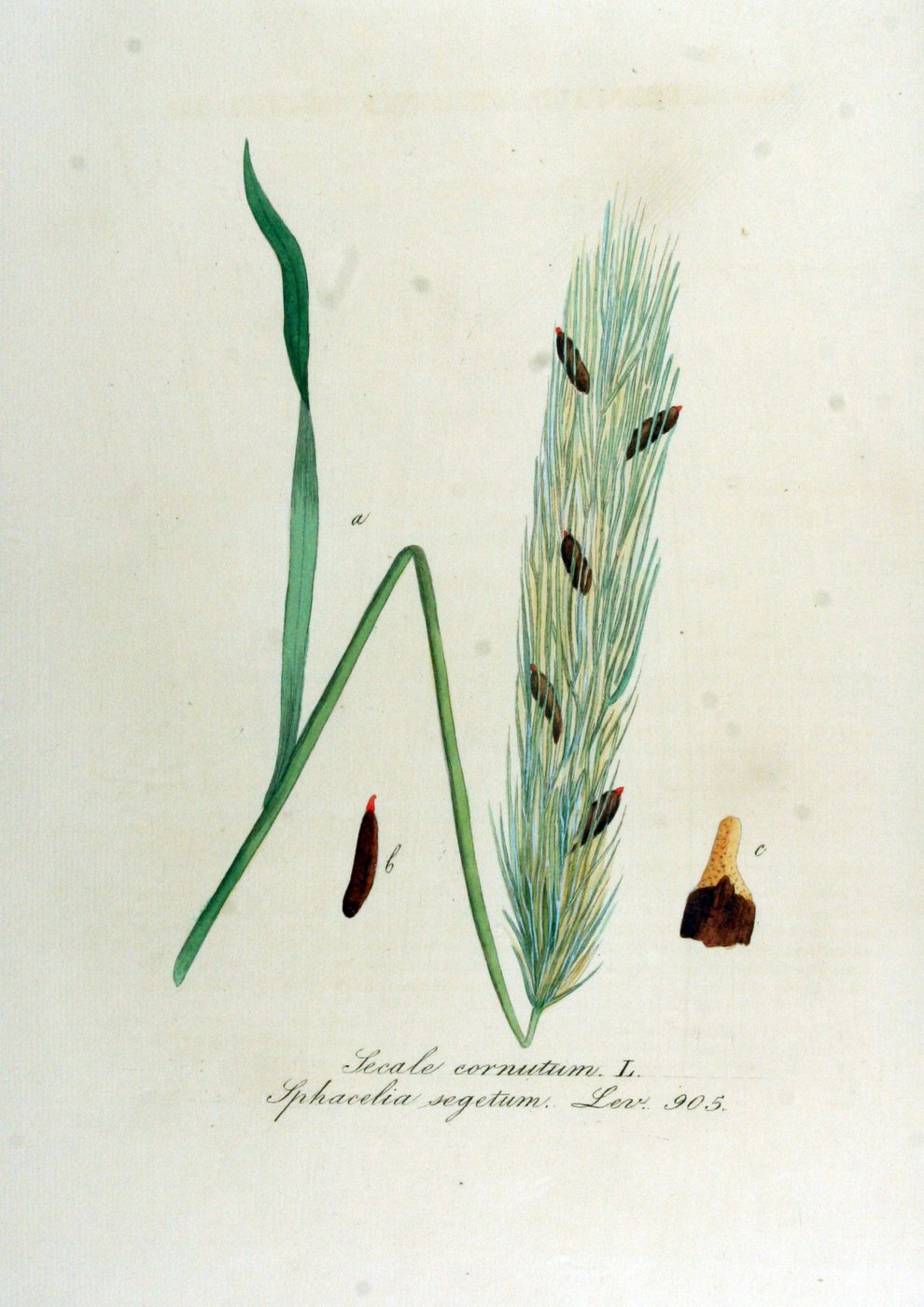
- The fungus Claviceps purpurea, which grows in the ear of rye in place of the grain as a long, black, slightly curved body.
- Kind
- Fungus, in 2 older authorities
- Constituents
- ergotamine, ergometrine, lysergic acid
- Poisoning
- Ergotism
- Earliest authority here
- St. Anthony’s fire
- In other databases
- GBIF search · Wikidata search
Revised October 3, 2026: Checked against its sources, each read in full, in part, or in its abstract. Version 1, first published September 25, 2026.
Deadly. Poisonous: convulsions, gangrene, miscarriage.
Ergot: what does modern science say?
Its alkaloids gave medicine ergotamine and ergometrine, and Albert Hofmann first made LSD from them in 1938.
Ergot: is it poisonous?
Yes, and it can kill. Poisonous: convulsions, gangrene, miscarriage. Its poisoning is ergotism: Days to weeks of eating the bread. Historical description, not medical advice; in a poisoning, call a poison centre.
Pharmacognosy & Toxicology
- Constituents
- ergotamine ChEMBL
- ergometrine ChEMBL
- lysergic acidthe parent of LSD
- Mechanism
- The ergot alkaloids constrict blood vessels and act on serotonin and dopamine receptors.
- Checked against ChEMBL
- ergotamine: ChEMBL’s curated mechanism: agonist 5-hydroxytryptamine receptor 1D; agonist Adrenergic receptor alpha.
- Toxic dose
- Chronic: bread of ergot-tainted rye; in rainy years rye bread was thought to exceed 5 per cent ergot.
- Syndrome
- Ergotism
- Standing
- Ergometrine is on the WHO List of Essential Medicines and is used for bleeding after childbirth; ergotamine is used for acute migraine.
Constituent names open the compound’s record at PubChem, and “ChEMBL” beside a name opens its record at ChEMBL, the European Bioinformatics Institute’s database of bioactive molecules. Where a mechanism line was checked against ChEMBL (ChEMBL 37, read 1 October 2026), the check is shown with the measured value and its source paper, or says plainly that nothing has been measured. Doses are as the references give them, for description only; this is not medical advice. Each source carries the result of its check against Crossref, PubMed, or the authority’s page: see Verification.
What Medicine Makes of It
- Ergot and the Witch TrialsThe 1976 hypothesis, and why most historians reject it.
Ergot: what lore surrounds it?
Ergotism’s convulsions and hallucinations have been proposed as a cause of some outbreaks once read as possession, most famously by Linnda Caporael for Salem in 1976; the theory remains disputed.
Ergot: what did the older authorities say?
- St. Anthony’s fire
- The burning limbs and gangrene of ergotism, epidemic in medieval Europe, were nursed by the Order of St. Anthony, whose saint had wrestled demons in the desert.
- The midwives
- Used it to hasten labor long before the physicians accepted it as pulvis parturiens.
Sources
- Wikipedia contributors. “Ergot.” Wikipedia, The Free Encyclopedia. en.wikipedia.org/wiki/Ergot (read 2 October 2026). Read in full · the text read
- Wikipedia contributors. “Ergotism.” Wikipedia, The Free Encyclopedia. en.wikipedia.org/wiki/Ergotism (read 2 October 2026). Read in full · the text read
- Wikipedia contributors. “Ergometrine.” Wikipedia, The Free Encyclopedia. en.wikipedia.org/wiki/Ergometrine (read 2 October 2026). Read in full · the text read
- Wikipedia contributors. “Ergotamine.” Wikipedia, The Free Encyclopedia. en.wikipedia.org/wiki/Ergotamine (read 2 October 2026). Read in full · the text read
- Wikipedia contributors. “Lysergic acid diethylamide.” Wikipedia, The Free Encyclopedia. en.wikipedia.org/wiki/Lysergic_acid_diethylamide (read 2 October 2026). Read in full · the text read
- Wikipedia contributors. “Lysergic acid.” Wikipedia, The Free Encyclopedia. en.wikipedia.org/wiki/Lysergic_acid (read 2 October 2026). Read in full · the text read
- Wikipedia contributors. “Anthony the Great.” Wikipedia, The Free Encyclopedia. en.wikipedia.org/wiki/Anthony_the_Great (read 2 October 2026). Read in full · the text read
- Grieve, M. (1931). A Modern Herbal, “Fungi.” London: Jonathan Cape. botanical.com/botanical/mgmh/f/fungi-37.html (read 2 October 2026). Read in part · the text read
- Wikipedia contributors. “Claviceps purpurea.” Wikipedia, The Free Encyclopedia. en.wikipedia.org/wiki/Claviceps_purpurea (read 2 October 2026). Read in full · the text read
Verification
- Checked
- October 1, 2026, and October 3, 2026
- Passes
- Every sentence read against its sources, in the pass over the remaining 343 entries
- The Standing line checked against the authority it names (EMA, WHO, FDA, CITES, Commission E)
- Every dated or regulatory claim checked by category across the database
- The mechanism read against ChEMBL (ChEMBL 37): curated mechanisms and measured activity
- Every source read, in full, in part, or in its abstract, and every sentence checked against what was read (October 3, 2026)
- Sources
- 9 cited: 8 read in full, 1 read in part.
- Corrections
- None were needed.
What was checked, how, and what was found is set out on the Verification page. A checked source is one whose record was found; it does not make the entry medical advice.
Cite This Entry
Version 1 · first published September 25, 2026 · last revised October 3, 2026
- Chicago
“Ergot.” In Materia Medica, edited by B. C. P. Statema. Version 1. The Thinking Press, 2026–. Last modified October 3, 2026. https://thethinkingpress.org/materia-medica/ergot.
- MLA
“Ergot.” Materia Medica, edited by B. C. P. Statema, version 1, The Thinking Press, 3 Oct. 2026, thethinkingpress.org/materia-medica/ergot. Accessed 8 Oct. 2026.
- APA
Ergot. (2026, October 3). In B. C. P. Statema (Ed.), Materia medica (Version 1). The Thinking Press. Retrieved October 8, 2026, from https://thethinkingpress.org/materia-medica/ergot
Club members keep entries on a shelf with private notes, print the plates as cards, and receive an entry by email each week. Create a free account before January 1, 2027 and all of it is yours for good. About the Club
See Also
Drawing on the same sources: Grieve
Nearby in the alphabet
Epsom salt (first boiled from the waters of a spring on Epsom Common in Surrey) · The exorcists’ manuals (above all those of the Franciscan Girolamo Menghi) · Epithymum (Cuscuta epithymum, a parasitic plant) · The eye bead (white, light blue, and black, like an eye) · Epiphany water (in the East as the Great Blessing of the Waters at Theophany) · Epiphany chalk

Historical description, not medical advice.