
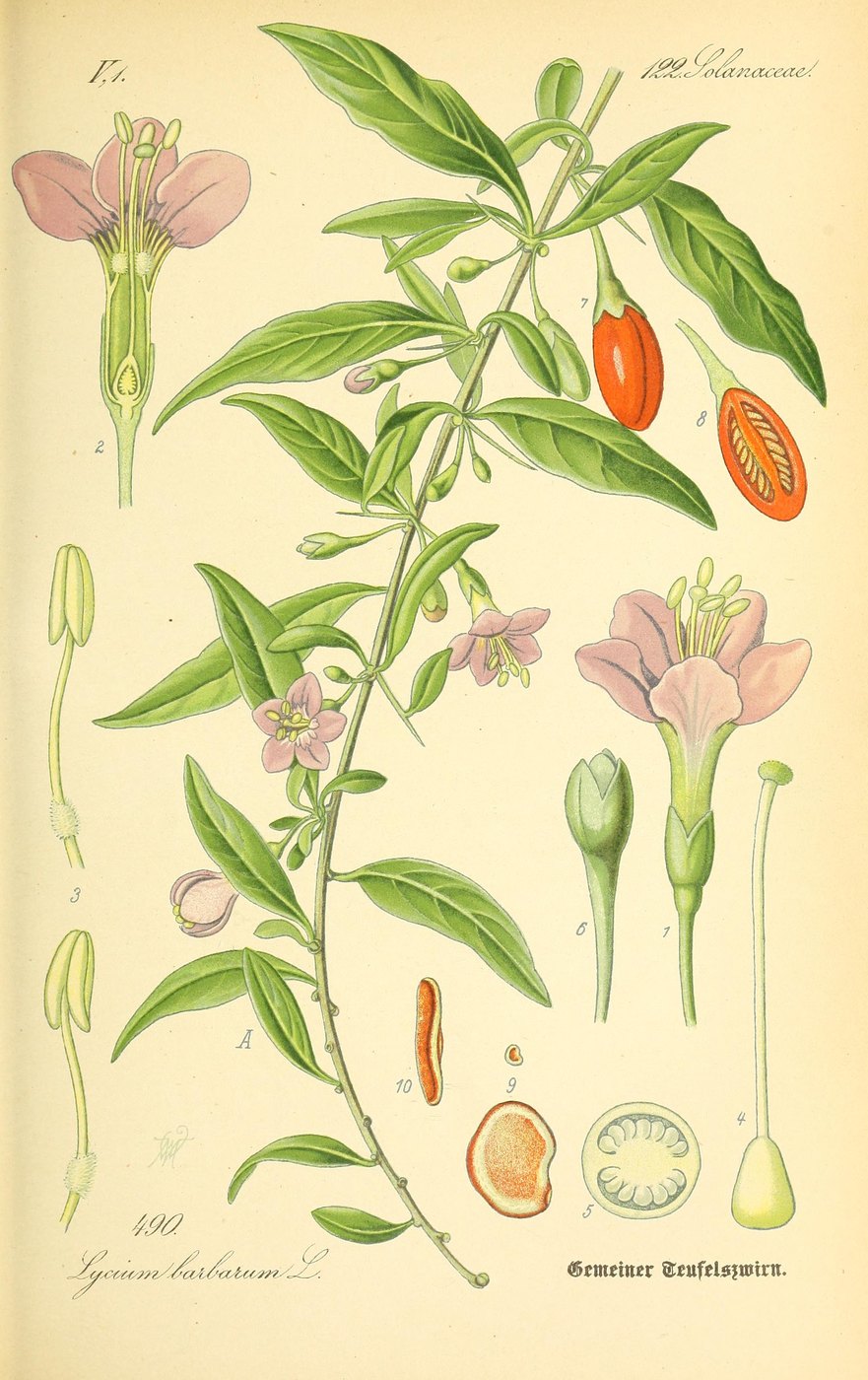
Goji berry
Wolfberry; the Chinese kou-chi in Stuart’s spelling, its fruit yang-ju, its root bark ti-ku-p’i, its leaves t’ien-ts’ai; Lycium barbarum and Lycium chinense; German Teufelszwirn and Bocksdorn, the devil’s thread and the buck’s thorn
- Known today as
- The scarlet berry of Lycium barbarum and Lycium chinense, thin-leaved shrubs of the nightshade family with long, rod-like, hanging branches and small violet flowers from June to autumn: a common shrub of the northern and western provinces of China, and in Europe a Mediterranean plant much planted and long since run wild.
- Kind
- Plant, in 3 older authorities
- Constituents
- Lycium barbarum polysaccharides, zeaxanthin, betaine
- Earliest authority here
- Pliny (AD 23/24–79)
- In other databases
- Plants of the World Online search · GBIF search · Wikidata search
Caution. A woman stabilised on warfarin drank three or four glasses a day of a concentrated tea of the fruit for four days and her clotting time rose; the two should not be combined.
Goji berry: what was it used for?
In Chinese medicine, by Stuart’s account of the Pen-ts’ao, the plant as a whole is tonic, cooling, and constructive, prolonging life, improving the complexion, and brightening the eye. The young shoots and leaves are recommended in all wasting diseases, and as a tea to quench thirst and relieve the symptoms of consumption; the root is given for the kidneys and the sexual organs and as a hemostatic for bleeding gums and wounds; the seeds likewise; and there are extracts, pills, and tinctures. The leaves, soft and thin, can be eaten; the berries are sweet with a rather rough taste.
Goji berry: how is it taken as a tea?
The young leaves as a tea to quench thirst and relieve the symptoms of consumption, by the Chinese books as Stuart reports them. A concentrated tea of the fruit, three or four glasses a day for four days, was enough to disturb a woman’s warfarin.
All the herbal teas of the database. Historical directions, not medical advice.
Goji berry: what does modern science say?
A 2017 review counts more than two thousand years of Chinese use and lists what the berry holds: the Lycium barbarum polysaccharides that are its principal active fraction, betaine, phenolics, the carotenoids zeaxanthin and β-carotene, a stable glucoside of ascorbic acid, β-sitosterol, flavonoids, and the vitamins riboflavin, thiamine, and ascorbic acid; the anti-ageing effects reported for the polysaccharides, it concludes, rest on basic science and need further study. Two trials: in 34 healthy adults, two weeks of a standardised goji juice raised questionnaire ratings of energy, sleep, focus, and contentment while the measured weight, blood pressure, pulse, and visual acuity did not change; and in 150 people of 65 to 70, ninety days of a milk-based goji formulation raised plasma zeaxanthin by 26 percent and antioxidant capacity by 57 percent, and the macula stayed stable where the placebo group’s lost pigment and gained soft drusen, though the authors could find no relation between the two changes.
Pharmacognosy & Toxicology
- Constituents
- Lycium barbarum polysaccharidesthe primary active components of the berry, to which its reported anti-ageing effects are laid
- zeaxanthinthe carotenoid of the berry, with β-carotene; plasma zeaxanthin rose 26 percent in ninety days of a goji formulation
- betainewith phenolics, a cerebroside, β-sitosterol, flavonoids, a stable glucoside of ascorbic acid, and the vitamins riboflavin, thiamine, and ascorbic acid
- Mechanism
- The polysaccharides are reported, by the 2017 review, to act through antioxidant, immunoregulative, and anti-apoptotic activities and by reducing DNA damage, on evidence the authors call basic and in need of further study. The berry’s tea weakly inhibited the enzyme CYP2C9 that clears the active form of warfarin in the laboratory, too weakly, the case report judged, to explain the whole of the clotting change it saw.
- Toxic dose
- 120 millilitres a day of a standardised juice for fourteen days in the one general trial; 13.7 grams a day of a milk-based formulation for ninety days in the eye trial; three or four glasses a day of a concentrated tea in the warfarin case.
- Standing
- A food with a long medicinal reputation and two small trials behind it, one of questionnaire ratings and one of the macula; the eye trial’s authors could not relate the change they measured to the zeaxanthin they also measured.
- Gao, Y., Wei, Y., Wang, Y., Gao, F., & Chen, Z. (2017). Lycium barbarum: a traditional Chinese herb and a promising anti-aging agent. Aging and Disease 8: 778–791. doi:10.14336/AD.2017.0725 Verified against its record · PMID 29344416
- Amagase, H., & Nance, D. M. (2008). A randomized, double-blind, placebo-controlled, clinical study of the general effects of a standardized Lycium barbarum (goji) juice, GoChi. Journal of Alternative and Complementary Medicine 14: 403–412. doi:10.1089/acm.2008.0004 Verified against its record · PMID 18447631
- Bucheli, P., et al. (2011). Goji berry effects on macular characteristics and plasma antioxidant levels. Optometry and Vision Science 88: 257–262. doi:10.1097/OPX.0b013e318205a18f Verified against its record · PMID 21169874
- Lam, A. Y., Elmer, G. W., & Mohutsky, M. A. (2001). Possible interaction between warfarin and Lycium barbarum L. Annals of Pharmacotherapy 35: 1199–1201. doi:10.1345/aph.1Z442 Verified against its record · PMID 11675844
The abstract of each source, beneath its citation. For Club members. About the Club or sign in.
Constituent names open the compound’s record at PubChem, and “ChEMBL” beside a name opens its record at ChEMBL, the European Bioinformatics Institute’s database of bioactive molecules. Where a mechanism line was checked against ChEMBL (ChEMBL 37, read 1 October 2026), the check is shown with the measured value and its source paper, or says plainly that nothing has been measured. Doses are as the references give them, for description only; this is not medical advice. Each source carries the result of its check against Crossref, PubMed, or the authority’s page: see Verification.
Goji berry: what lore surrounds it?
A plant of two names in two worlds: the devil’s thread of German hedges, where Thomé found it escaped from gardens, and the life-prolonging kou-chi of the Chinese books, whose fruit, Stuart says, the Chinese hold to brighten the eye. The one clinical trial of it on the eye, ninety days of goji in milk, is among the few in which an old claim and a modern measurement have met.
Goji berry: what did the older authorities say?
- Pliny
- The lycium of the ancients was not this plant but a medicament of eighteen remedies boiled from the bitter branches and roots of a thorn, three days in a copper vessel until it had the consistency of honey, the Indian sort the best: for the eyes, for itch-scabs, for the gums, for coughs, and for wounds. Linnaeus gave the old name to the genus of the goji.
- The Pen-ts’ao, as G. A. Stuart reports it
- Porter Smith had mistaken the kou-chi for a barberry; Stuart sets it right as a solanaceous shrub. Its general action “is considered to be tonic, cooling, constructive, prolonging life, improving the complexion, and brightening the eye”; the shoots in wasting disease, the leaves as a tea, the root for the kidneys and for bleeding.
- O. W. Thomé
- In the German flora the common Teufelszwirn, Lycium barbarum, is an unarmed or thorny shrub with thin, rod-like, overhanging branches, a light red to violet corolla, stamens standing out of it, and a scarlet berry, flowering from June into autumn to a height of about two and a half metres: a plant of the Mediterranean region, much planted and much run wild.
Sources
- Stuart, G. A. (1911). Chinese Materia Medica: Vegetable Kingdom, “Lycium chinense,” pp. 250–251. Internet Archive, b31350033. Standard reference work
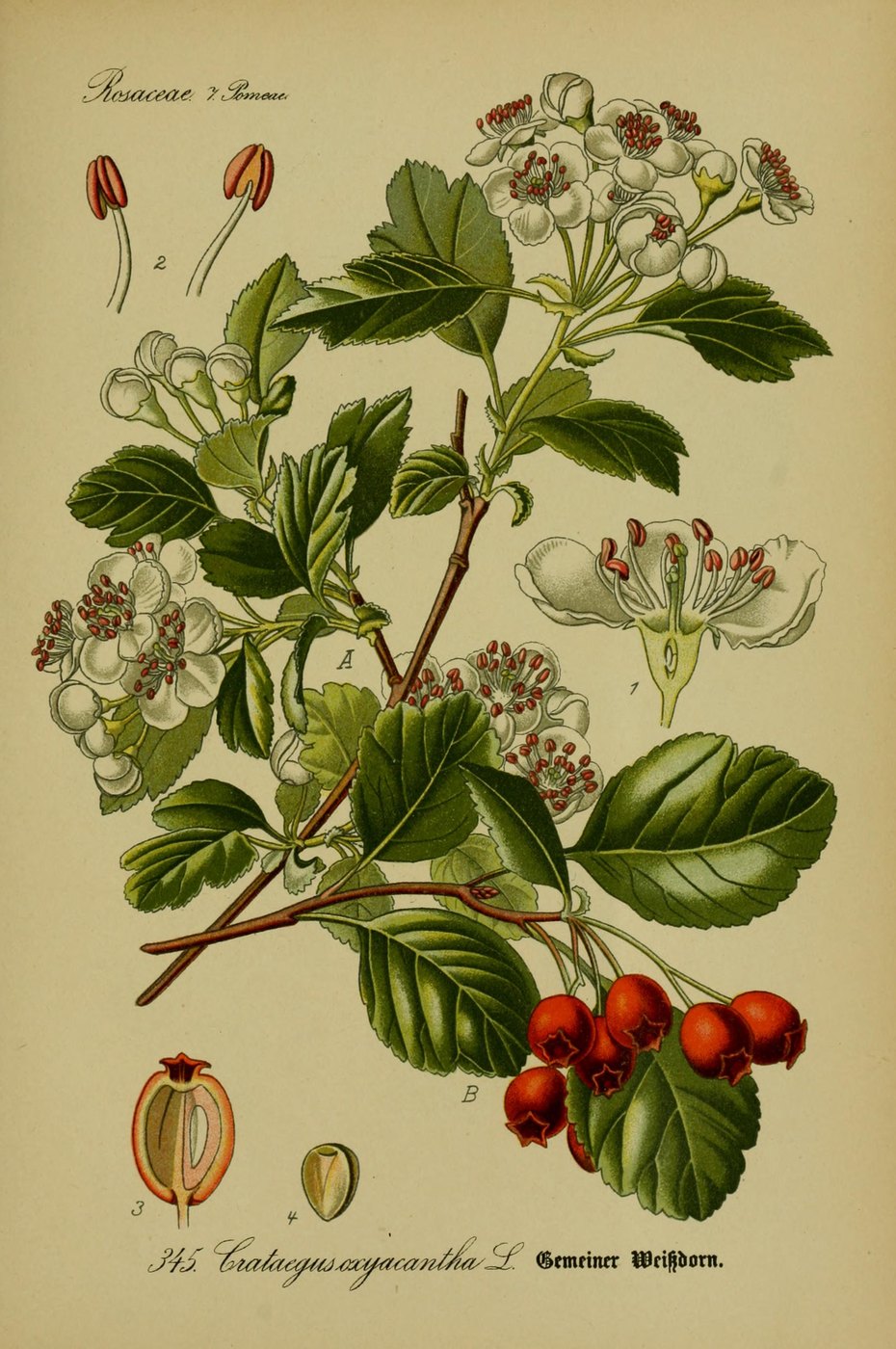
- Thomé, O. W. (1889). Flora von Deutschland, Österreich und der Schweiz, Bd. 4, “Gattung 641: Lycium,” and Tafel 490. Internet Archive, profdrthomesflor41889thom. Primary text
- Pliny the Elder. The Natural History, trans. John Bostock and H. T. Riley, vol. 5, Book 24, chs. 76–77, “Lycium: eighteen remedies.” Project Gutenberg, 60688. Primary text
Verification
- Checked
- October 1, 2026
- Passes
- Every sentence read against its sources, in the pass over the remaining 343 entries
- The Standing line checked against the authority it names (EMA, WHO, FDA, CITES, Commission E)
- Every dated or regulatory claim checked by category across the database
- Sources
- 7 cited: 4 verified against its record, 2 primary text, 1 standard reference work. 4 with the abstract on file.
- Corrections
- None were needed.
What was checked, how, and what was found is set out on the Verification page. A checked source is one whose record was found; it does not make the entry medical advice.
Cite This Entry
Version 1 · first published October 4, 2026
- Chicago
“Goji berry.” In Materia Medica, edited by B. C. P. Statema. Version 1. The Thinking Press, 2026–. Last modified October 4, 2026. https://thethinkingpress.org/materia-medica/goji-berry.
- MLA
“Goji berry.” Materia Medica, edited by B. C. P. Statema, version 1, The Thinking Press, 4 Oct. 2026, thethinkingpress.org/materia-medica/goji-berry. Accessed 8 Oct. 2026.
- APA
Goji berry. (2026, October 4). In B. C. P. Statema (Ed.), Materia medica (Version 1). The Thinking Press. Retrieved October 8, 2026, from https://thethinkingpress.org/materia-medica/goji-berry
Club members keep entries on a shelf with private notes, print the plates as cards, and receive an entry by email each week. Create a free account before January 1, 2027 and all of it is yours for good. About the Club
See Also
Also in Pliny the Elder
Gold leaf in Pliny the Elder · Ginger in Pliny the Elder · Gorse in Pliny the Elder · Fig in Pliny the Elder · everything Pliny the Elder names →
Drawing on the same sources: Stuart
Nearby in the alphabet
Goat’s rue (French lilac) · Gold, frankincense, and myrrh (The gifts of the Magi) · Glauber’s salt · Golden pills (a standard compound of aloes, scammony, and colocynth) · Glass powder (Powdered glass)
Historical description, not medical advice.