
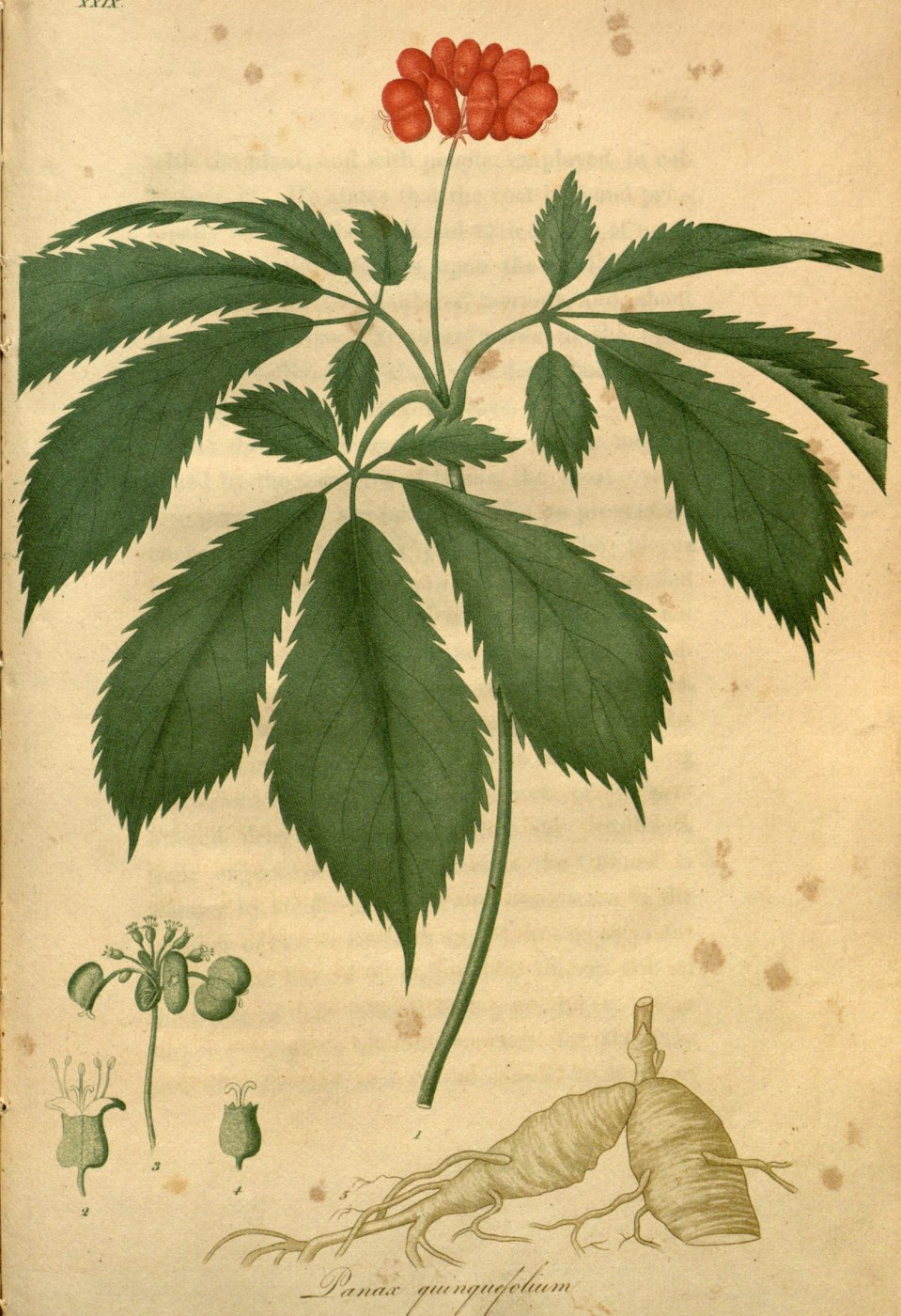
Ginseng
American ginseng, Panax quinquefolius of Linnaeus, Aralia quinquefolia; Asiatic, Chinese, or Korean ginseng, Panax ginseng; Five Fingers, Tartar Root, Red Berry, Man’s Health; Chinese jen-shen, “like a man”; Iroquois garantoquen; Ninsin of the old pharmacies
- Known today as
- Panax quinquefolius, the ginseng of the North American woods, and its Asian kin Panax ginseng: a slow-growing herb of rich shade with three leaves of five toothed leaflets, a head of small greenish flowers, bright scarlet berries, and a fleshy, forked, man-shaped root that China has bought for its weight in silver.
- Kind
- Plant, in 4 older authorities
- Constituents
- ginsenosides, a gummy mucilage
- Earliest authority here
- Father Jartoux, as Bigelow gives him
- In other databases
- Plants of the World Online search · GBIF search · Wikidata search
Caution. American ginseng lowered the effect of warfarin in a controlled trial, and anyone on that drug should say so to a physician. The trials of Panax ginseng recorded only minor adverse events.
Ginseng: what was it used for?
In China, by the account of Father Jartoux that Bigelow reprints, a decoction of about a fifth of an ounce of the root, boiled in a covered vessel with two successive waters: the sick took it to recover health and the healthy to make themselves stronger, and it was held to remove all fatigue of body or mind, cure the lungs, strengthen the stomach, and prolong life. The Chinese physicians, Stuart says, call it a tonic to the five viscera, quieting the animal spirits, establishing the soul, allaying fear, and brightening the eye, and prescribe it in nearly every severe disease: all forms of debility, dyspepsia, old coughs, chronic malaria, and exhausting discharges. In America, Bigelow placed it among the demulcents beside liquorice, and quoted Dr. Fothergill that a decoction had been of service in the tedious chronic coughs of the old; most of it was sold by the druggists as a masticatory, “one of the most innocent articles for this purpose.”
Ginseng: foraging it in the Midwest
- Part
- Root
- When
- Autumn, when the red berries are ripe
The Ojibwe gathered it assiduously for the traders and thoughtfully: only when the red berries were mature and before they dropped, so the seed went back into the ground; the Forest Potawatomi used the root as medicine. Rich shaded woods; protected and regulated nearly everywhere now.
After Smith. All the foragables of the Midwest. Historical record, not a field guide: identify before you gather, and read the whole entry.
Ginseng: how is it taken as a tea?
The Chinese decoction, by Father Jartoux as Bigelow gives him: about a fifth of an ounce of the root boiled in a covered vessel with two successive waters, to draw all its virtue. The Tartars often brought Jartoux the leaves instead of tea, and he found himself so well afterwards that he preferred them to the best tea.
All the herbal teas of the database. Historical directions, not medical advice.
Ginseng: what does modern science say?
A 2013 systematic review found 65 randomised controlled trials of Panax ginseng, most of them on psychomotor or physical performance, and judged that there was no conclusive evidence for its use in any particular disease, though the results for glucose metabolism and the immune response were promising; across 40 trials that recorded adverse events, 135 minor ones and none serious. The Cochrane review of ginseng for cognition found nine placebo-controlled trials, could pool none of them, and concluded there was a lack of convincing evidence of a cognitive effect in healthy people and no high-quality evidence in dementia. For American ginseng, a trial of 290 cancer patients found non-significant trends toward less fatigue at 1,000 to 2,000 milligrams a day and no excess toxicity; and in twenty healthy volunteers two weeks of American ginseng reduced the anticoagulant effect of warfarin.
Pharmacognosy & Toxicology
- Constituents
- ginsenosidesthe major active ingredients of Panax ginseng, about forty of them reported, each a saponin; research now studies single ginsenosides rather than the whole root
- a gummy mucilagetaken up by cold and hot water and thrown down by alcohol, with a volatile oil in the distilled water, little resin, and no tannin, by Bigelow’s tests of the American root
- Mechanism
- By the 2018 review, ginseng and its ginsenosides have shown antioxidant, anti-inflammatory, vasorelaxant, antiallergic, antidiabetic, and anticancer actions in the laboratory, and in animals and people effects on the vessels through the control of vasomotor function, ion channels and signalling, lipid profiles, blood pressure, cardiac function, and platelet adhesion. In twenty healthy volunteers American ginseng lowered the peak plasma level of warfarin and its anticoagulant effect, so the interaction is pharmacokinetic in part.
- Toxic dose
- The Chinese decoction, a fifth of an ounce of root boiled with two waters, by Jartoux; 750, 1,000, or 2,000 milligrams a day of American ginseng in the cancer-fatigue trial, with signs of benefit only at the two higher doses.
- Standing
- Sixty-five randomised trials by 2013 and no conclusive evidence for any disease, with promise for glucose metabolism and the immune response; the Cochrane review found no convincing evidence for cognition. Minor adverse events only in the trials, but a demonstrated interaction with warfarin.
- Kim, J. H. (2018). Pharmacological and medical applications of Panax ginseng and ginsenosides: a review for use in cardiovascular diseases. Journal of Ginseng Research 42: 264–269. doi:10.1016/j.jgr.2017.10.004 Verified against its record · PMID 29983607
- Shergis, J. L., Zhang, A. L., Zhou, W., & Xue, C. C. (2013). Panax ginseng in randomised controlled trials: a systematic review. Phytotherapy Research 27: 949–965. doi:10.1002/ptr.4832 Verified against its record · PMID 22969004
- Geng, J., et al. (2010). Ginseng for cognition. Cochrane Database of Systematic Reviews: CD007769. doi:10.1002/14651858.CD007769.pub2 Verified against its record · PMID 21154383
- Barton, D. L., et al. (2010). Pilot study of Panax quinquefolius (American ginseng) to improve cancer-related fatigue: a randomized, double-blind, dose-finding evaluation: NCCTG trial N03CA. Supportive Care in Cancer 18: 179–187. doi:10.1007/s00520-009-0642-2 Verified against its record · PMID 19415341
- Yuan, C. S., et al. (2004). Brief communication: American ginseng reduces warfarin’s effect in healthy patients: a randomized, controlled trial. Annals of Internal Medicine 141: 23–27. doi:10.7326/0003-4819-141-1-200407060-00011 Verified against its record · PMID 15238367
The abstract of each source, beneath its citation. For Club members. About the Club or sign in.
Constituent names open the compound’s record at PubChem, and “ChEMBL” beside a name opens its record at ChEMBL, the European Bioinformatics Institute’s database of bioactive molecules. Where a mechanism line was checked against ChEMBL (ChEMBL 37, read 1 October 2026), the check is shown with the measured value and its source paper, or says plainly that nothing has been measured. Doses are as the references give them, for description only; this is not medical advice. Each source carries the result of its check against Crossref, PubMed, or the authority’s page: see Verification.
Ginseng: what lore surrounds it?
Stuart tells the story the Chinese books tell of its finding: in the reign of Wenti of the Sui dynasty, at Shangtang in Shensi, a man’s imploring voice was heard each night behind a certain house, and when they searched they found, a li away, a remarkable ginseng plant; dug to the depth of five feet, the root had the shape of a man with four limbs perfect and complete, and it was this that had been calling in the night. They called it the spirit of the ground. Whoever would find the plant in Manchuria looks for the tree it is thought to love, and the Manchurians boast that the weeds of their country are the choice drugs of the Chinese.
The name Panax is Greek for the panacea, given by Linnaeus for the reputed character of the Chinese drug. Bigelow records that in the French years the Indians about Quebec and Montreal were so wholly taken up in the search for ginseng that their services could not be engaged for anything else, until the shipments overstocked the Chinese market and the price fell; Grieve gives the later figures, 550,624 pounds exported from America in 1876 at a dollar seventeen, and 155,308 in 1912 at seven dollars twenty.
Ginseng: what did the older authorities say?
- Father Jartoux, as Bigelow gives him
- The Jesuit at Pekin, travelling the mountains of Tartary under the emperor’s sanction, saw the root gathered by an army of ten thousand Tartars in 1709, each bound to present the emperor two ounces of the best and sell him the rest for its weight in silver. Having taken half a root himself, “he found his pulse quicker and fuller, his appetite improved, and his strength increased so as to bear labour better than before”; and the Tartars often brought him the leaves instead of tea, which he found he preferred to the best tea.
- Jacob Bigelow
- The Boston physician found the American plant “precisely the same with the Asiatic,” and remarked that the Chinese and the North American Indian names both signify a resemblance to the figure of a man, “though this resemblance, it must be confessed, is rather of a humble kind.” Tried in America and Europe, its virtues did not justify the Chinese estimate: “a whole root may be eaten without inconvenience,” and its place is among the demulcents, nearer liquorice than any other medicine.
- The Pen-ts’ao, as G. A. Stuart reports it
- With the Chinese “the medicine par excellence; the dernier ressort when all other drugs fail,” reserved for the Emperor and his household and conferred on high officials in a serious breakdown. The best is the wild root of Manchuria, then the Korean; the American sort is thought much inferior. To test a root, two men walk together, one with a piece in his mouth: if after three to five li he is not tired while the other is out of breath, the drug is true.
- Mrs. M. Grieve
- Sarrasin sent specimens from Canada to Paris in 1704, and in 1718 the Jesuits of Canada began shipping the root to China, the first cargo to Canton yielding enormous profits; by 1748 it sold at a dollar a pound in America and nearly five in China. The Indian collectors gathered it only after the fruit was ripe and bent the stem down before digging the root, to sow its seeds; still it was exterminated in many districts, and Canada fined collecting between January and September. Not an official medicine, but a place in the eclectic Materia Medica.
Sources
- Bigelow, J. (1818). American Medical Botany, vol. 2, “Panax quinquefolium. Ginseng,” pp. 82–96 and Plate XXIX. Internet Archive, mobot31753000788221. Primary text
- Stuart, G. A. (1911). Chinese Materia Medica: Vegetable Kingdom, “Panax Ginseng,” pp. 301–304. Internet Archive, b31350033. Standard reference work
- Grieve, M. A Modern Herbal, “Ginseng.” As published on botanical.com. Standard reference work
Verification
- Checked
- October 1, 2026
- Passes
- Every sentence read against its sources, in the pass over the remaining 343 entries
- The Standing line checked against the authority it names (EMA, WHO, FDA, CITES, Commission E)
- Every dated or regulatory claim checked by category across the database
- Sources
- 8 cited: 5 verified against its record, 1 primary text, 2 standard reference work. 5 with the abstract on file.
- Corrections
- None were needed.
What was checked, how, and what was found is set out on the Verification page. A checked source is one whose record was found; it does not make the entry medical advice.
Cite This Entry
Version 1 · first published October 4, 2026
- Chicago
“Ginseng.” In Materia Medica, edited by B. C. P. Statema. Version 1. The Thinking Press, 2026–. Last modified October 4, 2026. https://thethinkingpress.org/materia-medica/ginseng.
- MLA
“Ginseng.” Materia Medica, edited by B. C. P. Statema, version 1, The Thinking Press, 4 Oct. 2026, thethinkingpress.org/materia-medica/ginseng. Accessed 8 Oct. 2026.
- APA
Ginseng. (2026, October 4). In B. C. P. Statema (Ed.), Materia medica (Version 1). The Thinking Press. Retrieved October 8, 2026, from https://thethinkingpress.org/materia-medica/ginseng
Club members keep entries on a shelf with private notes, print the plates as cards, and receive an entry by email each week. Create a free account before January 1, 2027 and all of it is yours for good. About the Club
See Also
Also in M. Grieve
Ground cherry in M. Grieve · Clove in M. Grieve · Mayapple in M. Grieve · Burdock in M. Grieve · everything M. Grieve names →
Drawing on the same sources: Bigelow, Stuart, Grieve
Bloodroot · Pokeweed · Goji berry · Human fat · Ginger · Ground pine · the bibliography →
Nearby in the alphabet
Glass powder (Powdered glass) · Glauber’s salt · Ghost pipe · Goat’s rue (French lilac) · Garlic (Allium sativum) · Gamboge (yellow as egg yolk)
Historical description, not medical advice.