
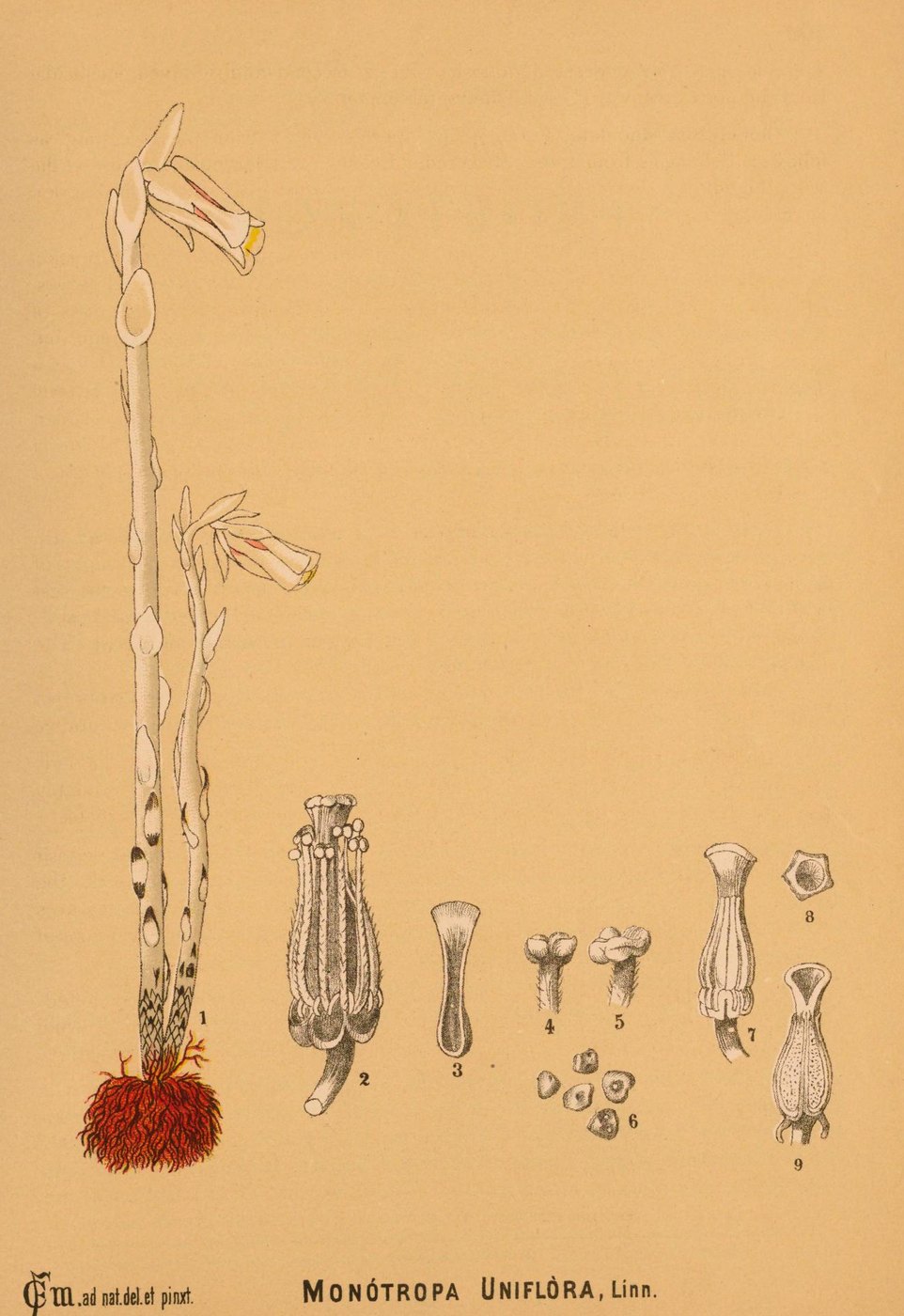
Ghost pipe
Indian pipe, Indian ghost pipe, corpse plant, ice plant, bird’s nest, fit-root, convulsion-root, pipe plant, ova-ova; Monotropa uniflora of Linnaeus, “one turn,” from the single nodding flower
- Known today as
- Monotropa uniflora, a leafless, waxy, ivory-white herb of deep shady woods, two to eight inches high, with scales for leaves and one nodding flower that stands upright in fruit: a plant without green that lives through the fungi on the roots of trees, cool and clammy to the touch, melting in the hand like ice, and turning jet-black when it dries. It grows from Maine to Carolina and west to Missouri, and from Florida to Mississippi northward, flowering in July in the North.
- Kind
- Plant, in 3 older authorities
- Constituents
- none established, grayanotoxins, penidaleodiolides A and B
- Earliest authority here
- Charles F. Millspaugh
- In other databases
- Plants of the World Online search · GBIF search · Wikidata search
Caution. The juice on chapped lips once raised sores, by Millspaugh’s one case; the poisonous principle reported in 1889 was not found in fifty samples in 2025. Its modern use for pain rests on tradition and a survey, not on a trial.
Ghost pipe: what was it used for?
The Indians, Millspaugh says, valued the juice mixed with water for sore eyes, and Dr. Kunze of New York applied the fresh juice to inflamed eyelids and to the eyes of infants a few days old, and cured a friend’s chronic inflammation of the lids in four weeks. King’s Dispensatory gives the root as a tonic, sedative, nervine, and antispasmodic, used in the fevers, and in the convulsions of children, epilepsy, and chorea, whence the names fit-root and convulsion-root: half a drachm to a drachm of the powder two or three times a day, sometimes with valerian, and “as a substitute for opium, without any deleterious influences.” The juice, alone or with rose-water, for obstinate inflammations of the eye and for ulcers. In eastern Kentucky today the flower is taken for pain, and a recent survey of its use across the United States, as the Kentucky review reports it, found it taken chiefly for pain and also for sleep, grief, anxiety, inflamed eyes, and spiritual well-being.
Ghost pipe: foraging it in the Midwest
- Part
- Root and flowering plant
- When
- July to September
Deep rich shady woods, the beech woods above all; the Potawatomi medicine woman Mrs. Spoon made a tea of the roots for female troubles. The plant blackens in the hand and will not keep.
After Smith; Millspaugh. All the foragables of the Midwest. Historical record, not a field guide: identify before you gather, and read the whole entry.
Ghost pipe: what does modern science say?
Little. Millspaugh could find no analysis of the plant in 1887, and the review of eastern Kentucky’s medicinal plants in 2025 found that not many pharmacological studies had been done on it: one isolated a fungus, Penicillium daleae, from the plant, and from the fungus two cage-like polyketides that regulated neurotransmission in mouse neurons. The one claim of poison has been answered: a single study of 1889 had reported grayanotoxin I, the poison of the rhododendrons, in the plant, and in 2025 mass spectrometry of fifty samples detected neither grayanotoxins nor their analogues, refuting it. The plant has lately seen a rise in consumption across the country, which is why the question was asked.
Pharmacognosy & Toxicology
- Constituents
- none establishedMillspaugh could find no analysis of the plant in 1887; the related Monotropa hypopitys yields a volatile oil and methyl salicylate
- grayanotoxinsreported once in 1889 and not detected in fifty samples by mass spectrometry in 2025
- penidaleodiolides A and Bcage-like polyketides from a Penicillium isolated from the plant, not from the plant itself, with neurotransmission-regulating activity in mouse neurons
- Mechanism
- Unknown. The traditional use for pain has no trial and no identified constituent behind it; the one laboratory finding concerns compounds of a fungus living in the plant.
- Toxic dose
- Half a drachm to a drachm of the powdered root two or three times a day, by King’s; the juice to the eye, by Kunze.
- Standing
- A plant in revival whose only alleged poison has been looked for and not found, and whose uses rest on nineteenth-century practice and a modern survey.
- Anez, S. G., Flail, D. B., Burkhart, E. P., & Kellogg, J. J. (2025). Targeted and untargeted mass spectrometry do not detect grayanane-type toxins in Monotropa uniflora L. Journal of Natural Products 88: 2540–2545. doi:10.1021/acs.jnatprod.5c00805 Verified against its record · PMID 40982630
- Veldhi, P., Crager, C., Ghayur, A., Ul-Haq, Z., & Ghayur, M. N. (2025). A review and survey of local eastern Kentucky medicinal plants and their pharmacological benefits. Plants 14: 3182. doi:10.3390/plants14203182 Verified against its record · PMID 41157739
The abstract of each source, beneath its citation. For Club members. About the Club or sign in.
Constituent names open the compound’s record at PubChem, and “ChEMBL” beside a name opens its record at ChEMBL, the European Bioinformatics Institute’s database of bioactive molecules. Where a mechanism line was checked against ChEMBL (ChEMBL 37, read 1 October 2026), the check is shown with the measured value and its source paper, or says plainly that nothing has been measured. Doses are as the references give them, for description only; this is not medical advice. Each source carries the result of its check against Crossref, PubMed, or the authority’s page: see Verification.
Ghost pipe: what lore surrounds it?
Emily Dickinson, thanking her cousins for a sprig of witch-hazel in November 1876, wrote that she had seen it only once before, “and it haunted me like childhood’s Indian pipe, or ecstatic puff-balls, or that mysterious apple that sometimes comes on river-pinks.” The plant that haunts is the plant of the names: corpse plant for its colour, ice plant for its melting in the hand, ghost pipe for its white stem and bowed head. Millspaugh records the one case against it, a young lady who crushed a stem while examining it at home and had the juice driven onto her chapped lips, which swelled and broke into small sores for four or five days, “very much like a mild case of poisoning with Rhus toxicodendron”; and that attempts to keep the plant in alcohol turn it bluish-black and tinge the spirit a deep reddish-violet.
Ghost pipe: what did the older authorities say?
- Charles F. Millspaugh
- “This curious herb well deserves its name of corpse plant, so like is it to the general bluish waxy appearance of the dead; then, too, it is cool and clammy to the touch, and rapidly decomposes and turns black even when carefully handled.” Its medical history begins with the Indians’ use of the juice for sore eyes; the former uses in the spasms of children gave it its popular names. The tincture of the whole fresh plant is a brilliant orange-red by transmitted light, with a bitterish odour and a decidedly sweet taste. Not in the Pharmacopoeia, and no officinal preparation in the Eclectic Materia Medica.
- King’s American Dispensatory
- “The whole plant is ivory-white in all its parts, resembling frozen jelly, and is very succulent and tender, so much so that when handled it dissolves and melts away in the hands like ice.” The root, gathered in September and October and kept in well-stopped bottles, is tonic, sedative, nervine, and antispasmodic; it is reputed to have cured remittent and intermittent fevers; in the convulsions of children, epilepsy, and chorea its administration “has been followed with prompt success.” Lasché in 1889 reported a crystallisable poisonous principle in it, andromedotoxin, found in other heaths. “This plant is undoubtedly one of value, and deserving of more confidence and attention than is at present bestowed upon it. It is, however, seldom or never used at the present day.”
- Dr. R. E. Kunze, as Millspaugh quotes him
- Woodcock-shooting in a beech grove near Hackensack in early July, he and his friends came on the plant in full bloom, “a space some five feet wide by nine feet long” of snow-white stems and nodding flowers. A friend with chronically inflamed eyelids took to applying the fresh juice of the stems, and “his inflamed lids were entirely cured in four weeks’ time.” Kunze had himself applied it to the eyes of infants only days old, and in old age, “and even where not successfully employed no ill effects have ever been observed thereafter.”
Sources
- Millspaugh, C. F. (1887). American Medicinal Plants, vol. 1, no. 105, “Monotropa uniflora,” and Plate 105. Internet Archive, americanmedicina01mill_0. Primary text
- Felter, H. W., & Lloyd, J. U. (1898). King’s American Dispensatory, “Monotropa.—Indian Pipe.” As transcribed at Henriette’s Herbal Homepage, henriettes-herb.com. Standard reference work
- Dickinson, E. (1924). Letter to Louisa and Fannie Norcross, November 1876. In M. D. Bianchi (ed.), The Life and Letters of Emily Dickinson. Internet Archive, lifelettersofemi00unse. Primary text
Verification
- Checked
- October 1, 2026
- Passes
- Every sentence read against its sources, in the pass over the remaining 343 entries
- The Standing line checked against the authority it names (EMA, WHO, FDA, CITES, Commission E)
- Every dated or regulatory claim checked by category across the database
- Sources
- 5 cited: 2 verified against its record, 2 primary text, 1 standard reference work. 2 with the abstract on file.
- Corrections
- None were needed.
What was checked, how, and what was found is set out on the Verification page. A checked source is one whose record was found; it does not make the entry medical advice.
Cite This Entry
Version 1 · first published October 4, 2026
- Chicago
“Ghost pipe.” In Materia Medica, edited by B. C. P. Statema. Version 1. The Thinking Press, 2026–. Last modified October 4, 2026. https://thethinkingpress.org/materia-medica/ghost-pipe.
- MLA
“Ghost pipe.” Materia Medica, edited by B. C. P. Statema, version 1, The Thinking Press, 4 Oct. 2026, thethinkingpress.org/materia-medica/ghost-pipe. Accessed 8 Oct. 2026.
- APA
Ghost pipe. (2026, October 4). In B. C. P. Statema (Ed.), Materia medica (Version 1). The Thinking Press. Retrieved October 8, 2026, from https://thethinkingpress.org/materia-medica/ghost-pipe
Club members keep entries on a shelf with private notes, print the plates as cards, and receive an entry by email each week. Create a free account before January 1, 2027 and all of it is yours for good. About the Club
See Also
Drawing on the same sources: Millspaugh, Felter
Ground cherry · Burdock · Mayapple · Chokecherry · Pokeweed · the bibliography →
Nearby in the alphabet
Ginger (The rhizome of Zingiber officinale) · Garlic (Allium sativum) · Ginseng · Gamboge (yellow as egg yolk) · Glass powder (Powdered glass) · Gallia moschata (made into troches of aloeswood, ambergris, and musk) · Glauber’s salt · Galbanum (Gum resin of Ferula gummosa)
Historical description, not medical advice.