
The Mushroom
Toadstool, fungus
What shows for a night, from what lives on unseen.
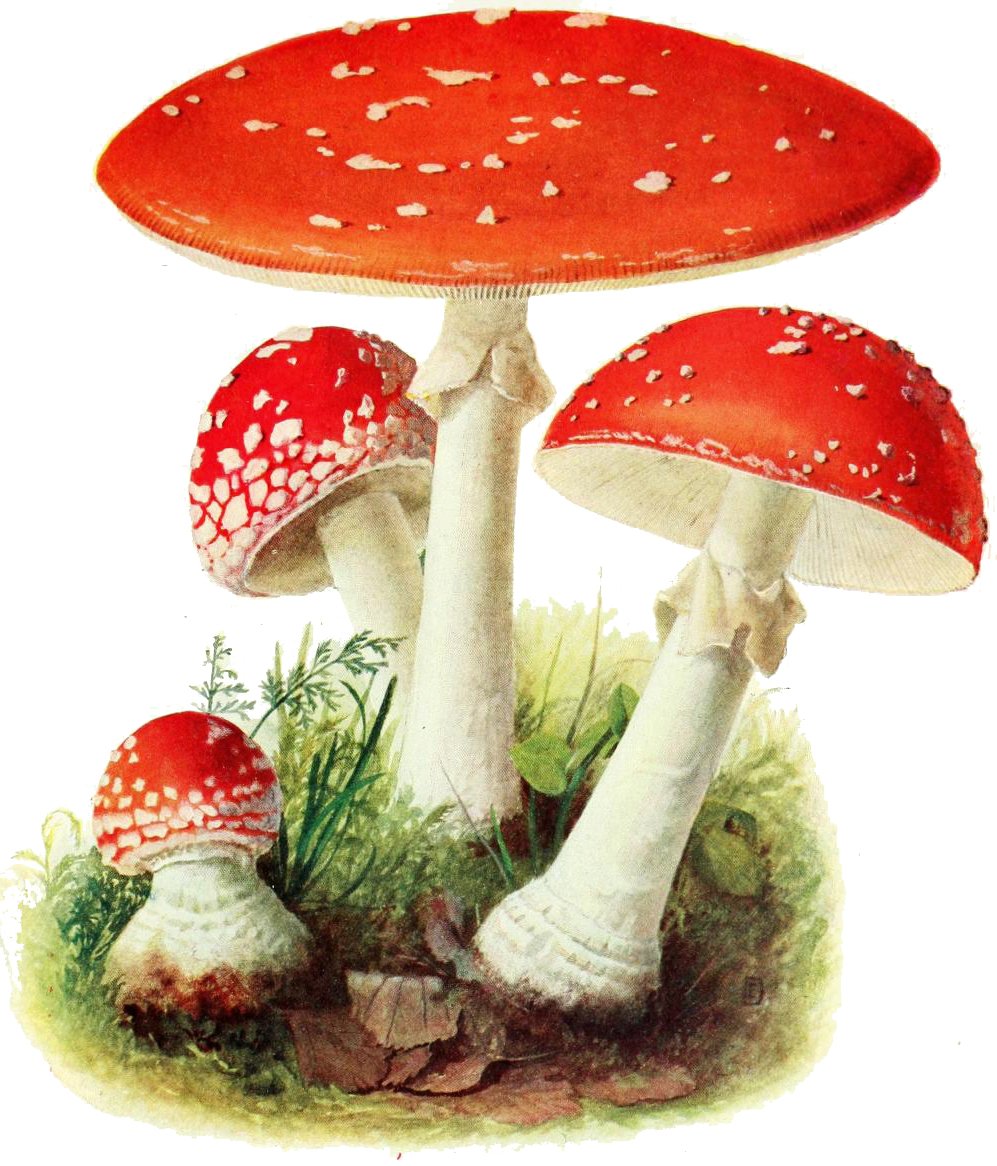
The plate: Amanita muscaria (fly agaric). Emil Doerstling, in Eugen Gramberg, Pilze der Heimat, Plate 64 (1913). Source.
The Mushroom: what does it mean in analytical psychology?
A mushroom is only the fruiting body of a fungus: it seems to come up overnight, and is soon gone, while the mycelium it rises from, a branching mass of threads in the soil or the rotting wood, can be long-lived and vast: one colony in the United States is estimated at 2,400 years old and 2,200 acres. Freud took that picture for the dream itself. Even the best interpreted dream, he wrote in the last chapter of The Interpretation of Dreams, leaves a portion in obscurity, where the dream thoughts merge “in all directions into the net-like entanglement of our world of thoughts,” and “it is from some denser portion of this texture that the dream-wish then arises like the mushroom from its mycelium.” The place where the threads can no longer be followed he called the keystone of the dream, “the place at which it mounts into the unknown.”
Jung closed the preface to his memoirs with a plant of the same kind, though he named a rhizome, not a fungus: “Life has always seemed to me like a plant that lives on its rhizome. Its true life is invisible, hidden in the rhizome. The part that appears above ground lasts only a single summer. What we see is the blossom, which passes. The rhizome remains.” Read with either of them, a mushroom in a dream is something come up out of what is hidden: small, sudden and soon gone, and the sign of a life below that has been growing for a long time.
Karl Albert Scherner, whose Life of the Dream (1861) the press has translated, read one of his own dreams of fungi as the body speaking. He went to light a fire in the stove for a dear relative and found in a corner of it “a group of broad tree-fungi standing next to one another” and a bright-white network of roots spreading through it. The stove was his dreaming mind’s usual image for the lung; the fungi, he decided, were the lungs’ wings and the white network the branching of the windpipe.
Modern research has set the dream beside the state that the “magic” mushrooms induce. A 2017 review found that psychedelic states and night dreams share perception, imagery, the stirring of emotion and the sense of self and body, and that the psychedelic state is closest to lucid dreaming, a mixture of dreaming and waking. A 2023 paper set Freud’s theory beside predictive processing and psychedelic research, finding in both dreaming and the psychedelic state the associative, non-rational thinking Freud called the primary process, in which what is unconscious may become accessible in symbolic forms.
The Mushroom: where does it appear in myth and tradition?
The fairy ring, called the witches’ circle in French and the witches’ ring in German, where elves and fairies were said to dance and a mortal who stepped in might be held, made to dance until exhausted, or cursed. The fly agaric, red with white spots, the toadstool of the picture books, used as a seat or a house by gnomes and fairies; Albertus Magnus, before 1256, said it was called the fly mushroom because it was powdered in milk to kill flies, and the Koryak of eastern Siberia told that it sprang from the spittle of the god Vahiyinin and gave Big Raven the strength to carry a whale home. Teonanácatl, whose ritual use by the Aztecs Sahagún reported, one of the mushrooms the peoples of Mesoamerica used for religious communion, divination and healing, and which the Spanish believed let them speak with demons. The stinkhorn, Gerard’s “pricke mushroom,” Phallus impudicus, the shameless phallus, whose unopened eggs the people of Thuringia called ghosts’ or demons’ eggs. Foxfire, the cold light of fungi in rotting wood, which Aristotle described as a light that, unlike fire, was cold to the touch. Alice’s mushroom in Wonderland, one side of which makes you grow taller and the other shorter.
Mushrooms in dreams: what do the kinds, the forms, and the places mean?
What the old dream books and the traditions say of each kind of mushroom, of what is done with it, and of where it grows. The dream books were written to tell fortunes, and they disagree; each reading is given with the book or the tradition it comes from, for the dreamer to weigh against the dream.
The kinds
- Mushrooms, seen
- Unhealthy desires and unwise haste to grow rich, with wealth that may vanish in lawsuits and vain pleasures.Miller, Ten Thousand Dreams Interpreted, 1901.
- The red toadstool with white spots (the fly agaric)
- The enchanted world of the tales, where the gnomes and fairies sit and live; in the north, the shaman’s mushroom, a gift that the Koryak said Raven wished to grow forever so his children could learn from it. It is also the mushroom that changes the size of things: writers on fungi recorded the distortions of size it causes, and this is thought to lie behind Alice’s growing and shrinking.Wikipedia, “Amanita muscaria”, the sections on Siberia and on culture. See the Materia Medica.
- The “magic” mushroom
- A message from beyond the everyday: the peoples of Mesoamerica used these mushrooms for religious communion, divination and healing, and the Aztecs and Mazatecs called them the divinatory and the wondrous mushrooms. Research finds the state they bring on closest to lucid dreaming, so a dream of them may be a dream about dreaming itself.Wikipedia, “Psilocybin mushroom”, the history; Kraehenmann, 2017. See the Materia Medica.
- The stinkhorn
- Desire felt as shameful. Its Latin name means the shameless phallus; in The Magic Mountain its form is “reminiscent of love, and its odor, of death,” and Gwen Raverat, Darwin’s granddaughter, remembered her Aunt Etty hunting it in the woods by scent and burned the catch in secret on the drawing-room fire, “because of the morals of the maids.”Wikipedia, “Phallus impudicus”, the section on culture. See the Materia Medica and The Phallus.
- Tree-fungi, broad and growing side by side
- The body speaking in images: for Scherner, broad tree-fungi in a stove were the wings of the lungs, and the white network around them the branching windpipe. A dream of them may be a dream of breath.Scherner, The Life of the Dream, § 30. See the passage.
- Mushrooms that glow in the dark
- A light that is not fire: foxfire, the glow of fungi in rotting wood, was known to Aristotle as a light cold to the touch, and the “fox” in its name may come from the Old French faux, false. A guiding light in the dark, or a light to be distrusted.Wikipedia, “Foxfire”.
What is done with them
- Seeing them grow, or gathering them
- Riches gained by a splendid speculation, and poverty as sudden as the wealth: what comes up overnight goes as fast.Fontaine, The Golden Wheel Dream-book, 1862.
- Eating them
- The books disagree. Fontaine reads it as a long life, to a good old age; Miller as humiliation and disgraceful love.Fontaine, 1862; Miller, 1901.
- Eating one side and then the other, and growing and shrinking
- The caterpillar’s advice to Alice: “One side will make you grow taller, and the other side will make you grow shorter.” A dream of being too big or too small for the place one is in, and of a means to change it that is hard to measure.Carroll, Alice’s Adventures in Wonderland, chapter V.
- Being given a mushroom, as a flower is given
- In the language of flowers, a suspicion of infidelity; Fontaine’s list of the flowers’ sentiments gives the mushroom, unkindly, “Away! go home, and cry about it!”Cielo, Fortunes and Dreams, 1917; Fontaine, 1862.
- A young woman dreaming of mushrooms
- For Miller, defiance of propriety in pursuit of foolish pleasures: the reading of 1901, given as he gives it.Miller, Ten Thousand Dreams Interpreted, 1901.
- Destroying them, or ploughing up a ring of them
- A thing that will come back: the old belief held that destroying a fairy ring is unlucky and fruitless, and that it simply grows back. Like the mycelium, what is cut down above ground is not what lives.Wikipedia, “Fairy ring”, the section on folklore.
Where they grow
- In a ring in the grass
- A threshold best not crossed. Fairy rings were where elves, fairies or witches danced; one who stepped in might see them, but fell into their power, could not leave, and was danced to exhaustion. In an Irish legend a farmer who built his barn on a fairy ring was struck senseless, and dreamed that he must destroy the barn.Wikipedia, “Fairy ring”, the section on folklore. See The Ring.
- Around a hawthorn tree
- The fairies’ own ground: an early twentieth-century Irish tradition held that fairies like to dance around the hawthorn, so that fairy rings often centre on one.Wikipedia, “Fairy ring”, the section on folklore. See The Tree.
- Inside the house, in the stove or by the hearth
- The body as a house: for Scherner the house is the dream’s usual picture of the body, and the stove of the lung, so that fungi growing there are the breathing organs pictured.Scherner, The Life of the Dream, § 30. See The House.
- In the forest, on rotting wood
- Life out of decay: the mycelium feeds on decaying wood and dying roots, and the glow of foxfire is found there.Wikipedia, “Mushroom” and “Foxfire”. See The Forest.
- Coming up everywhere, overnight
- Sudden growth, in the sense of the English verb: to mushroom is to expand rapidly, to pop up like a mushroom to appear unexpectedly. Something has been growing out of sight for longer than it seemed.Wikipedia, “Mushroom”, on growth.
- Underground, the threads beneath
- What the dream comes from: Freud’s mycelium, the net of thoughts below every dream, which no interpretation follows to its end.Freud, The Interpretation of Dreams, chapter VII.
From the Sources
Freud on the point where interpretation runs out: the dream thoughts merge into a net, and the dream-wish rises out of it as a mushroom rises from its mycelium.
“It is from some denser portion of this texture that the dream-wish then arises like the mushroom from its mycelium.”
Sigmund Freud, The Interpretation of Dreams, chapter VII, (a) “Forgetting in Dreams”. Translated by A. A. Brill, authorised translation of the third edition, New York: The Macmillan Company, 1913 (Project Gutenberg eBook #66048). The text, read in part
Jung’s image of life as a plant whose true life is hidden underground, with only a passing growth above.
“Life has always seemed to me like a plant that lives on its rhizome. Its true life is invisible, hidden in the rhizome. The part that appears above ground lasts only a single summer. What we see is the blossom, which passes. The rhizome remains.”
C. G. Jung, Memories, Dreams, Reflections, the close of the preface. Recorded and edited by Aniela Jaffé, New York: Pantheon Books, 1963, as quoted on Wikiquote, “Carl Jung”. The text, read in part
Scherner reads his own dream of fungi in a stove as an image of the lungs.
“Evidently the image of broad tree-fungi standing next to one another is a very beautiful and pure image for the shaping of the lungs' wings, while the spreading of the bright network of roots through the stove is an equally beautiful representation of the rich branching of the windpipe in the lung.”
Karl Albert Scherner, The Life of the Dream, § 30, “Fourth Principal Group: The Nerve-Stimulus Dreams”. Translated by B. C. P. Statema, The Thinking Press, 2026. The text, read in part
Miller’s dream book on seeing and eating mushrooms.
“To see mushrooms in your dreams, denotes unhealthy desires, and unwise haste in amassing wealth, as it may vanish in law suits and vain pleasures.”
Gustavus Hindman Miller, Ten Thousand Dreams Interpreted, “Mushroom”. New York: G. W. Dillingham Company, 1901 (Project Gutenberg eBook #926). The text, read in part
Fontaine’s dream book, which reads the eating of mushrooms the other way from Miller.
“To dream you eat mushrooms is a sign you will live to a good old age, but to dream you see them grow, or gather them, is a sign you will get rich by a splendid speculation, and then get poor as suddenly as you got wealthy.”
Felix Fontaine, The Golden Wheel Dream-book and Fortune-teller, “Mushroom”. New York: Dick & Fitzgerald, entered 1862 (Project Gutenberg eBook #60045). The text, read in part
The caterpillar on the mushroom tells Alice how to change her size.
“One side will make you grow taller, and the other side will make you grow shorter.”
Lewis Carroll, Alice’s Adventures in Wonderland, chapter V, “Advice from a Caterpillar”. 1865 (Project Gutenberg eBook #11). The text, read in part
Each passage is quoted from the text named, which the press fetched and read, and was checked word for word against a fresh copy of it; the link opens that copy. Passages are given as printed, without the editors’ footnote numbers, and with words broken across lines joined.
In the Materia Medica
Fly agaric: the substance itself, as the old medicine used it and as it is known today.
Where to Read
- Sigmund Freud, The Interpretation of Dreams, tr. A. A. Brill (1913), chapter VII, (a) “Forgetting in Dreams”: the passage read, on Project Gutenberg
- C. G. Jung, Memories, Dreams, Reflections (1963), the close of the preface, read as quoted on Wikiquote
- Karl Albert Scherner, The Life of the Dream, § 30, the press’s translation: the heart- and lung-stimulus dreams read
- Gustavus Hindman Miller, Ten Thousand Dreams Interpreted (1901), “Mushroom”, read on Project Gutenberg
- Felix Fontaine, The Golden Wheel Dream-book and Fortune-teller (1862), “Mushroom” in the dreams and in the language of flowers, read on Project Gutenberg
- Astra Cielo, Fortunes and Dreams (1917), the language of flowers, read on Project Gutenberg
- Lewis Carroll, Alice’s Adventures in Wonderland (1865), the close of chapter IV and the opening of chapter V, read on Project Gutenberg
- Wikipedia: “Mushroom” (etymology, growth), “Mycelium” (the opening), “Fairy ring” (oral tradition and folklore), “Amanita muscaria” (taxonomy, psychoactive use, Siberia, culture), “Psilocybin mushroom” (history), “Phallus impudicus” (taxonomy, culture, where Gwen Raverat and Thomas Mann are quoted), and “Foxfire” (whole), each read at the revision linked
- R. Kraehenmann, “Dreams and Psychedelics: Neurophenomenological Comparison and Therapeutic Implications,” Current Neuropharmacology 15 (2017): 1032–1042, doi:10.2174/1573413713666170619092629: the abstract, read on PubMed
- M. Koslowski, M. P. de Haas and T. Fischmann, “Converging theories on dreaming: between Freud, predictive processing, and psychedelic research,” Frontiers in Human Neuroscience 17 (2023): 1080177, doi:10.3389/fnhum.2023.1080177: the abstract, read on PubMed
Jung’s writings are cited by the volume of the Collected Works (CW), Bollingen Series / Princeton, 1953–79.
Related Symbols
Also among Growing Things
“Learn as much as you can about symbolism; then forget it all when you are analysing a dream.”
Club members can point at a technical term in this entry, such as a constituent, an action, or a word of Jung’s, to read its definition from the source. The Club.
Cite This Entry
“The Mushroom.” In Symbols of the Psyche, the Symbolarium. The Thinking Press, 2026. https://thethinkingpress.org/symbolarium/psyche/mushroom.
Nearby in the alphabet: The Mountain: The height to be climbed, where heaven and earth meet. Multiplicatio: The finished stone increasing its power. The Navel: The centre of the body, and of the world. Night: The dark from which the day is born.

