
From Mandrake
The mandrake
Durante’s whole chapter on the mandrake, from his Latin verse to the oil that “brings on sleep.”
Conciliat somnum, sedat pariterq; dolores
Mandragoras, & mollit ebur; tubercula, strumas
Discutit, & collecta; iuuat serpentis ad ictus,
Expellit partus, & menstrua, detrahit atram
Tum vomitu bilem, & pituitam: inducit & inde
Humorem, ac frigus; largo demittit ad orcum
Et potu.
The mandrake brings on sleep and calms pains alike, and softens ivory; it scatters swellings, scrofulous glands and gatherings; it helps against the bites of serpents; it drives out the birth and the menses; it draws off black bile, and phlegm, by vomiting; and thence it brings on moisture and cold; and, drunk in a large draught, it sends a man down to the underworld.
Names. Greek, Μανδραγόρας. Latin, Mandragoras. Italian, Mandragora. Arabic, Fabora and Yabrohac. German, Alraun. Spanish, Mandragola. French, Mandragore and mandreglorie.
Kinds. It is found in two kinds: the black, which is the female, and the white, which is the male.
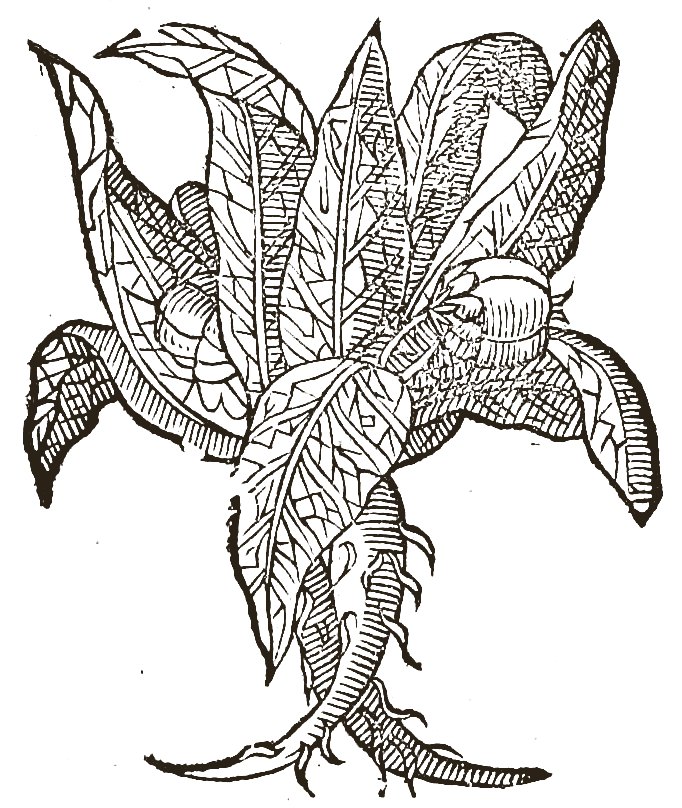
Form. The female makes leaves narrower and smaller than lettuce, of an unpleasant smell, and spread upon the ground. It makes flowers like those of melons, of a colour that turns from blue to purple. It bears fruits like sorb-apples, pale and fragrant, in which is a seed like that of pears. Its roots are large; it has now two, now three, twined about one another, black outside and white within, and covered with a thick bark. It puts up no stalk.
Place. It grows in plenty on Monte Gargano in Apulia, and is found also in the high mountains, and in many gardens here in Rome.
Quality. In the mandrake the cooling virtue prevails, so that it is set among the things that are cold in the third degree. Its apples, nonetheless, are found to have something of warmth, and likewise of moisture, and so they have the virtue of making one sleep. The bark of the root, being most powerful, not only cools but also dries; but what lies within it is of no worth.
Virtues. Inwardly. The juice drawn from the bark of the roots, drunk to the weight of two obols with honeyed wine, purges black bile and phlegm by vomiting, as hellebore does; but in truth, taken in too great a quantity, it is altogether deadly. A wine is made of the bark of the root, without boiling it, in this way. Three minas of its bark are put into a cadus of sweet wine. Then three cyathi of it are given to those on whom some limb must be cut, or the fire applied; for, sleeping deeply, they feel no pain at all. The wine in which the root has been boiled does the same, for it maddens and brings on lethargy; but the remedy is to bathe the head with vinegar, and to provoke sneezing with pepper or other medicines. The fragrant apples, smelled, and likewise eaten, make one sleep, and so does the juice pressed from them. But those who use them too freely, both eating them and smelling them, become mute. The mountebanks and the quacks falsely give simple, barren women to understand that by eating mandrakes they may have children. For those are roots of the stalks of bryony, and of other plants, carved into that shape and made with art, and then planted again with grains of barley set about the places where they wish those little roots to grow that make the hair, the beard, and the other hairs.
Virtues. Outwardly. The green leaves, or the green root, applied with honey and oil, heal fresh wounds. The root pounded with vinegar and applied puts out St Anthony’s fire powerfully. The same, plastered on with water, resolves scrofulas and tumours. With barley meal it eases the pains of the joints. The juice is put into the medicines for the eyes, and likewise into those made to ease pain. Applied below by itself, it draws down the menses, and likewise the birth. Put up as a suppository, it makes one sleep. It is said that if the root is boiled with ivory for six hours together, it softens it so that it may easily be shaped into whatever one wishes. The fresh leaves are fitly plastered, together with barley meal, on inflammations of the eyes, and they smooth away the edges of scars.
The oil of mandrake puts out every sort of inflammation, and brings on sleep.
Where this passage continues: Mandrake
Translation © 2026 B. C. P. Statema. The Thinking Press, Kenosha, Wisconsin. All rights reserved.
