The Beast
The monster
The impulse given a body, rising from the sea.
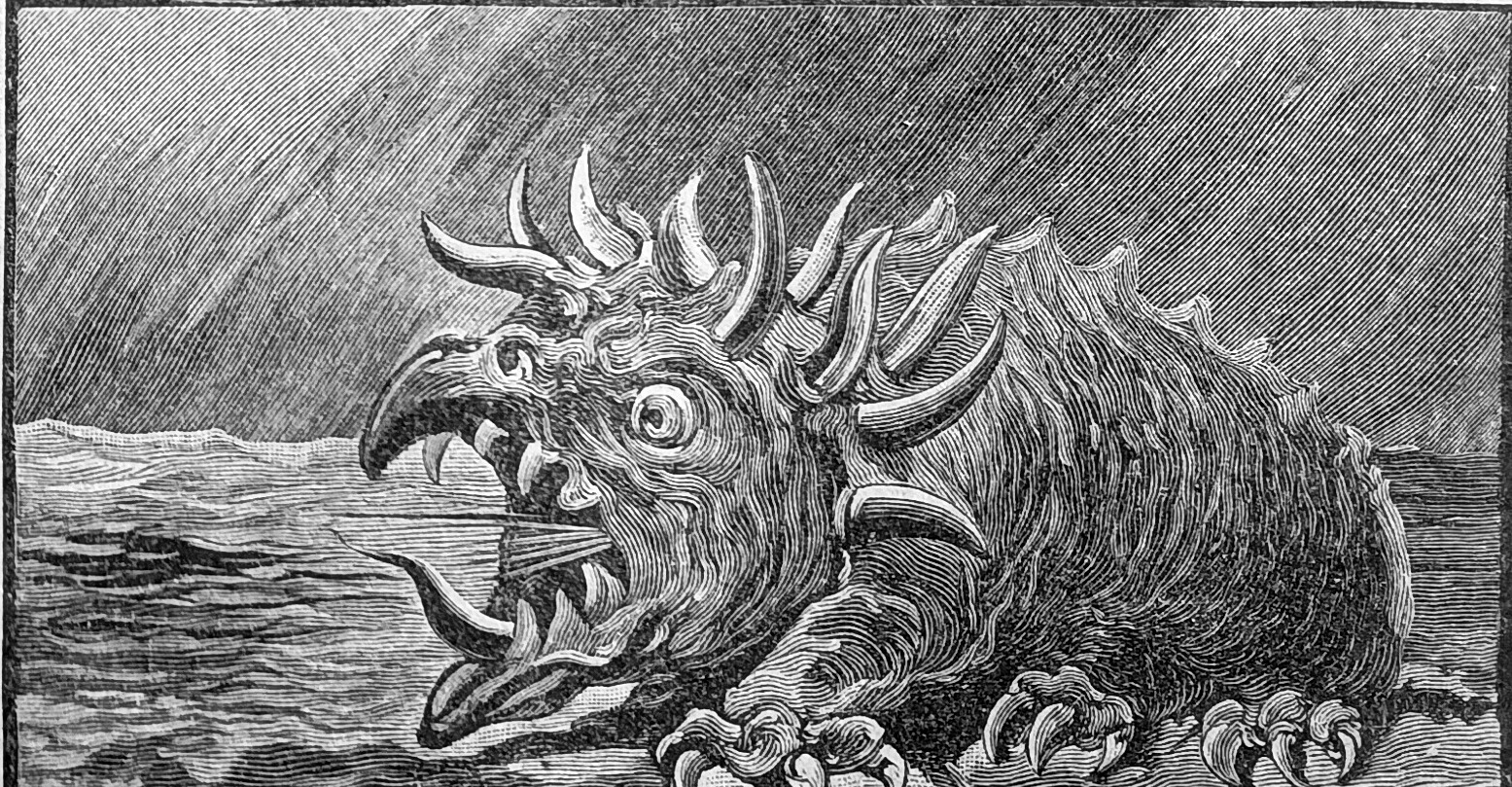
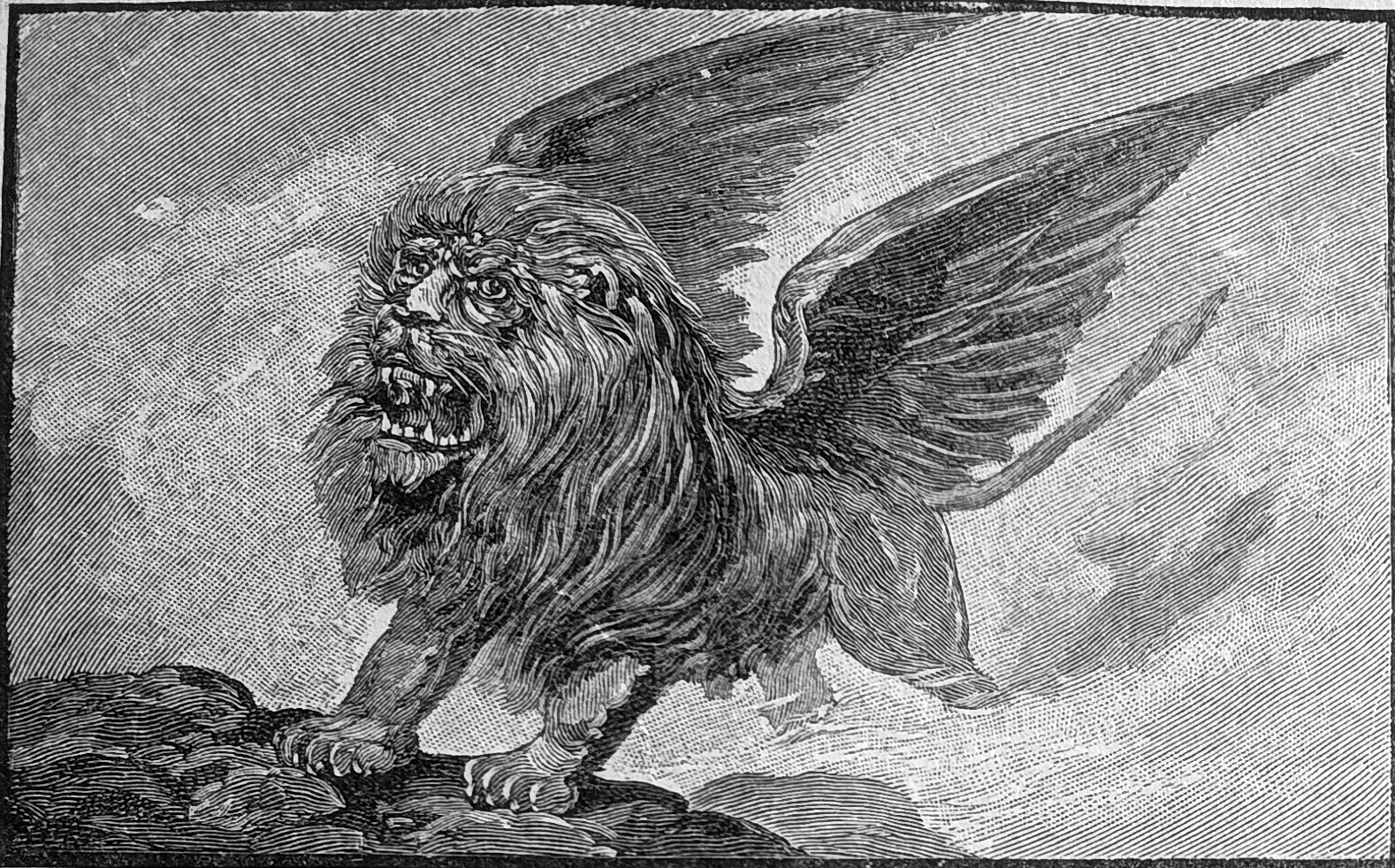
The plate: “Symbols of the Four Great Monarchies,” a plate “engraved expressly for ‘Bible Readings’” and copyrighted 1888, in Bible Readings for the Home Circle (Battle Creek, Mich.: Review and Herald Publishing Co., 1891), p. 26, photographed from the founder’s copy: the fourth beast, “dreadful and terrible, and strong exceedingly; and it had great iron teeth… and it had ten horns” (Daniel 7:7). Source.
The Beast: what does it mean in analytical psychology?
“The impulse is readily represented as an animal, as a bull, horse, dog, etc.,” Jung wrote, and “dreams swarm with such theriomorphic representations of the libido. Mixed beings… are not rare.” A patient afraid that his physician would forbid his adventures with women dreamt that the physician speared to the wall “a strange animal, half pig, half crocodile.”
The beast is that energy before it has a human face, and the man who prefers a secret life to a public one, Jung wrote, forgets “how dangerously their beasts lie in wait for each other.”
The Beast: where does it appear in myth and tradition?
The four great beasts that came up from the sea in Daniel’s dream, the fourth “dreadful and terrible, and strong exceedingly; and it had great iron teeth… and it had ten horns”; the beast of the Apocalypse rising from the sea with seven heads and ten horns, to which “the dragon gave him his power”; the half-human Sphinx at Oedipus’s gate.
Where to Read
- Jung, Psychology of the Unconscious (1916, tr. Hinkle), part II, chs. 4 and 5
- Daniel 7:2–8; Revelation 13:1–2 (King James Version)
Jung’s writings are cited by the volume of the Collected Works (CW), Bollingen Series / Princeton, 1953–79.
Related Symbols
Also among Animals
- The Serpent
- The Uroboros
- The Dragon
- The Salamander
- The Bird
- The Eagle
- The Phoenix
- The Pelican
- The Owl
- The Raven
- The Dove
- The Cock
- The Swan
- The Horse
- The Lion
- The Bull
- The Wolf
- The Dog
- The Stag
- The Unicorn
- The Ape
- The Bear
- The Hare
- The Goat
- The Fox
- The Lamb
- The Cat
- The Camel
- The Fish
- The Whale
- The Crocodile
- The Crab
- The Toad
- The Spider
- The Bee
- The Butterfly
- The Scarab
- The Leopard
“Learn as much as you can about symbolism; then forget it all when you are analysing a dream.”
Club members can point at a technical term in this entry, such as a constituent, an action, or a word of Jung’s, to read its definition from the source. The Club.
Cite This Entry
“The Beast.” In Symbols of the Psyche, the Symbolarium. The Thinking Press, 2026. https://thethinkingpress.org/symbolarium/psyche/beast.
Nearby in the alphabet: The Bath: Immersion that cleanses and joins. The Bear: Instinctive strength, and a fierce mothering. The Bee: The ordered community, and souls on the wing. The Bird: Spirit, soul, and thought in flight.
