
Castore Durante · New Herbal · 3 of 13
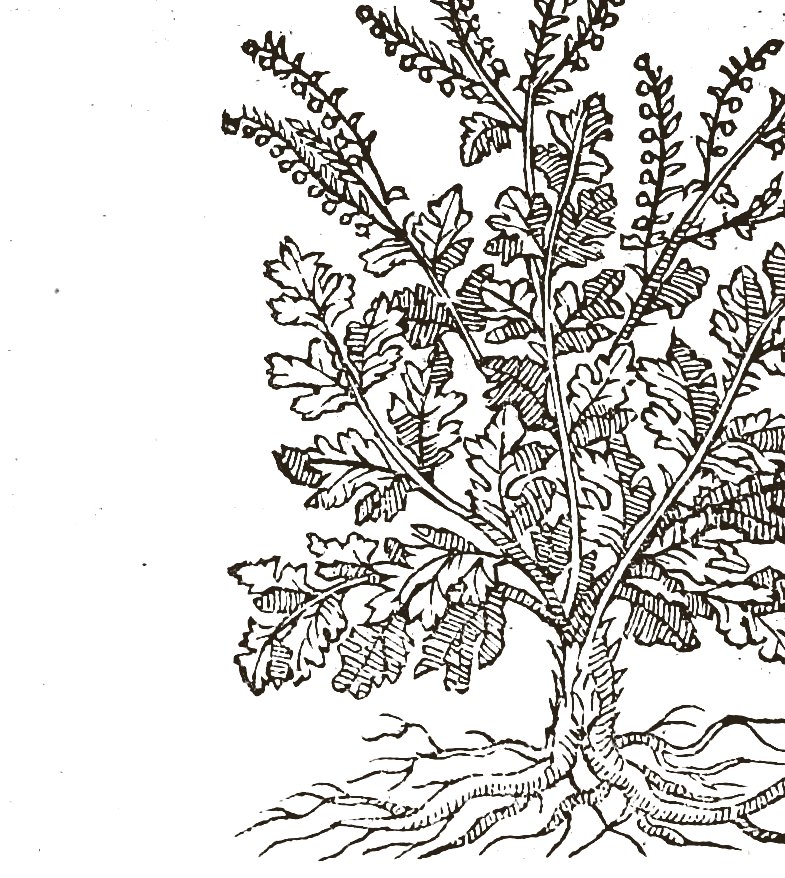
Wormwood
ASSENZO.
Taedia discutiunt, pelluntq; Absinthia menses,
Calfaciunt, stringunt, stomachum firmantque, cientq;
Vrinam, crapulamq; arcent, bilemq; repurgant;
Inflato & ventri, stomachiq; doloribus addunt
Auxilium, arquatos sanant, contraq; bibuntur
Perniciem fungorum, ad sugillata linuntur,
Ad purulentasq; aures, nubesq; oculorum;
Subueniunt iecori, ac spleni; murisq; venenis
Sunt aduersa, simul quae gestat Aranea, & iis, quae
Aequoreusq; draco, siue ixia, siue cicuta,
Atque diu stomacho affecto remouere laborem,
Vndae intraq; cutem possunt, & vermibus obstant.
Wormwoods scatter loathing and drive out the menses; they warm, they bind, they strengthen the stomach and call forth the urine; they ward off surfeit and purge away the bile; to a swollen belly and to pains of the stomach they bring help; they heal the jaundiced, and are drunk against the harm of mushrooms; they are smeared on bruises, on running ears, and on the clouds of the eyes; they come to the aid of the liver and the spleen; they are against the venom of the shrew, and of what the spider carries, and of what the sea-dragon, or ixia, or hemlock bring; they can long relieve the labour of an ailing stomach, and of the waters under the skin; and they stand against worms.
Names. Greek, Ἀψίνθιον. Latin, Asinthium. Italian, Assenzo. Spanish, Assentios, or Alosna. Arabic, Absynthium. German, Vuermuot. French, Absince.
Kinds. There are four kinds of wormwood: the common Pontic, the sea wormwood, the santonic, and the seriphian of Egypt.
Form. The common makes a branching stalk, and hoary leaves cut like those of mugwort and of feverfew. It makes very small yellow flowers, from which grow little round berries with the seed inside them. Its root is spreading, but firm and woody. Wormwood is gathered when it is heavy with seed, at the end of July, and dried in the shade.
Place. The common grows everywhere of itself, and is also sown. The Pontic grows in Pontus, in Hungary and in Bohemia; the santonic near the sea; and the seriphian in Egypt.
Quality. The Pontic, or Roman, is hot in the first degree and dry in the third, and its juice is much hotter than the herb. It is at once bitter, astringent and sharp; it is likewise warming, cleansing, strengthening and drying. The seriphian is a little hotter than the Pontic, and thins more; the santonic thins, warms and dries less than the seriphian.
Virtues. Inwardly. Wormwood does good to the stomach, helps digestion, warms the body, eases pains, and drives poisons and other harmful things out of the body; and the flowers boiled in wine, or the wine of wormwood, do the same. The flowers boiled in wine with cumin, drunk hot, ease the pains of the belly. It kills worms; it is healthful in the overflowing of the gall, and provokes the menses; drunk with vinegar it helps against venomous bites and against the choking of mushrooms. The seed, drunk, restrains dysentery and the flux. The herb boiled in wine kills worms. In choleric fevers wormwood is given when the signs of concoction appear, for it purges the choler that clings to the stomach and the bowels, not only through the belly but through the urine as well, strengthening the stomach and the liver and taking the pains from those members; it provokes the appetite, dissolves the wind of the body, and helps cold and moist infirmities. Wormwood eaten beforehand prevents the harm of surfeit. The wine of wormwood, made at the time of the vintage, is good for all these things; the juice, drunk, harms the stomach and makes the head ache. The water distilled from the leaves is more delicate, and does the same, but more weakly. A conserve of wormwood is made for the dropsical: take the flowers with the tenderest tops, and pound them with four times as much sugar until they are well joined together; then leave it, like the other conserves, to ferment well in the sun for a month. Half an ounce of it is given at a time, three hours before dinner; but whoever takes it should first be well purged. Various syrups, troches and oils are also made of wormwood for the infirmities named above, as will be seen in full in our Oracle of the Apothecaries.
Virtues. Outwardly. The water of wormwood laid on the temples eases a headache caused by cold; dropped into the eyes it clears the sight, and into the ears it takes away the matter. Wormwood pounded with honey and nitre and applied to the throat heals the quinsy. The steam of the decoction of wormwood eases the pain of the teeth and of the ears. Boiled in wine and plastered on, it eases the pain of the stomach and stops the hiccup, for which the oil is good as well. It keeps clothes from the moth; and its juice put into ink keeps the mice from books. Together with southernwood it keeps grain for many years from rotting, and from weevils and other small creatures; and if wild marjoram is set around it, the ants will not come near. Rubbed on with oil, it drives the fleas from the body. The decoction of wormwood sprinkled on the wall and on the bedding drives out the bedbugs. The juice heals wounds and the wormy sores of men and of other animals; the herb applied to wounds heals fractures.
Translation © 2026 B. C. P. Statema. The Thinking Press, Kenosha, Wisconsin. All rights reserved.
